847.849.2800
 Contact
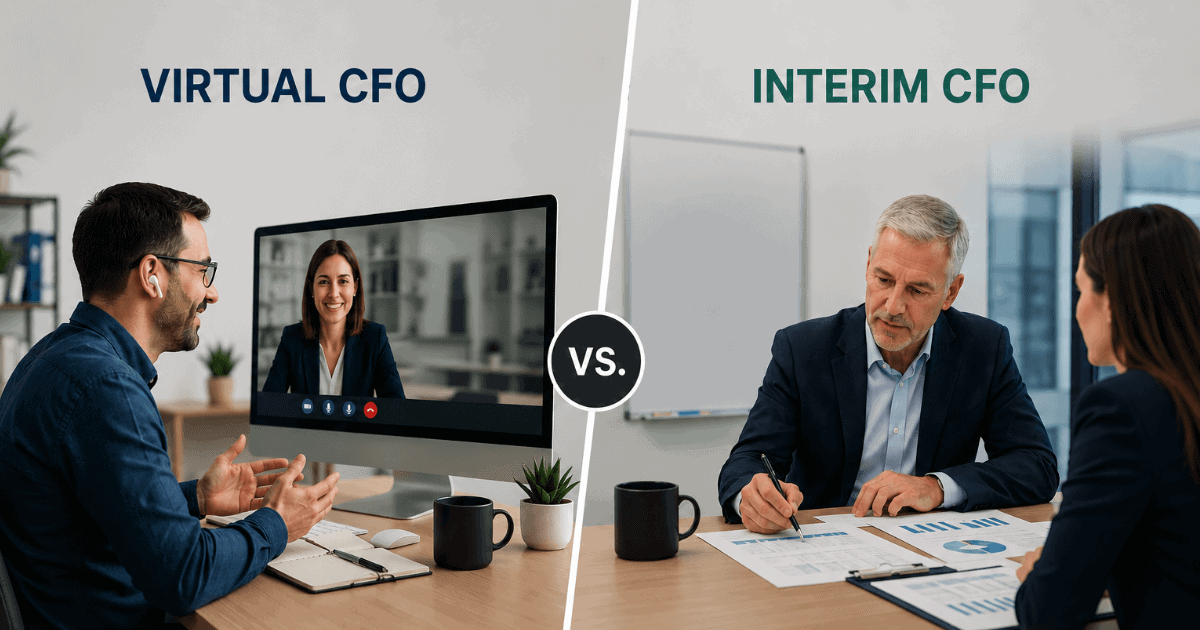
On paper, a virtual CFO looks like the fastest solution to a financial leadership gap. In practice, many executives discover too late that what they hired is a service, not a leader. When your company faces investor scrutiny, cash pressure, or a pivotal transition, the real decision executives face isn’t virtual versus in-house, it’s transactional support versus decisive leadership.
InterimExecs CEO Robert Jordan discussed the differences — and asked for insights on when an embedded CFO is the right move — in conversations with two successful interim Chief Financial Officers, Vic Datta and Mike Winer. Here’s what their years of experience have taught them.
The Real Difference Between Virtual, Fractional, and Interim CFOs
The term “virtual CFO” can mean a lot of different things. Many providers focus on bookkeeping, monthly close, and basic financial reporting. These services matter, but they stop short of true CFO accountability.
“A virtual CFO firm often delivers regular reporting and scheduled check-ins,” says Vic Datta, a CFO with deep experience in growth, restructuring, and private equity environments. “That works when the business is stable. But when you’re raising capital, resetting strategy, or facing pressure from the board, reporting alone doesn’t move the needle.”
An interim or fractional CFO operates differently. They step into the business as an executive. They shape strategy, lead the finance team, partner with the CEO, and own the financial narrative in the boardroom.
“When I take on an interim CFO role, I embed,” Datta says. “I’m not advising from the sidelines. I’m leading as if I’m the permanent CFO.”

Why Virtual CFOs Are Everywhere and When They Work
The rise of the virtual CFO reflects how modern businesses operate. Many companies are distributed, global, or growing faster than their internal infrastructure.
“Some businesses are international,” says Mike Winer. “Even a non-remote CFO is doing a lot of virtual work.”
Virtual CFOs also expand access to talent. “If the business is located in a difficult place, using a virtual CFO widens the talent pool quite a bit,” Winer says, “because they can provide services without having to commute to that hard-to-reach place.”
For companies with strong internal teams and straightforward needs, a virtual CFO can be effective, especially when the role includes senior-level insight, not just reporting.
Where Virtual CFO Models Break Down
Problems arise when companies expect a virtual CFO to deliver immediate, high-impact leadership during moments of stress.
“One challenge for virtual CFOs,” Winer says, “is the nuances and opportunities for rapid relationship building. It’s hard to establish in a very short time, virtually.”
That limitation matters most during critical transitions:
- Cash flow crises
- Capital raises
- Turnarounds or restructurings
- Private equity involvement
- CEO or finance team turnover
In these moments, speed matters. Trust matters. Presence matters.
How Interim CFOs Lead When It Matters Most
According to InterimExecs CEO Robert Jordan, companies often underestimate how much embedded leadership they need.
“Without a strong CFO, everything becomes harder,” Jordan says. “Raising capital, managing cash, hitting growth targets—it all slows down. Many executives realize too late that they needed a CFO six months earlier.”
True interim CFOs don’t operate as vendors. They operate as executives:
- They engage directly with boards and investors
- They stabilize teams and rebuild confidence
- They drive decisions, not just documentation
“I’ve flown across the country for a one-hour board prep meeting because that’s what the business needs,” Datta says. “That’s the difference. A real interim CFO does whatever it takes to lead through change.”
How Executives Should Decide
The right question isn’t whether you want a virtual CFO or an in-house interim. It’s whether your business needs support or leadership.
Executives should ask:
- Do we just need to close the books and stay compliant?
- Or do we need a CFO who can step in immediately, lead the team, and influence outcomes?
When the answer is leadership, an experienced interim CFO delivers impact faster than a long-term hire and with far less risk.
Bottom Line: Service Keeps You Running. Leadership Moves You Forward.
Titles don’t fix financial challenges. Leaders do.
“The best CFOs embed. They take ownership,” Datta says.
When your business reaches a moment that matters—growth, crisis, capital, or change—choosing embedded CFO leadership isn’t just a staffing decision. It’s a strategic one.
When your business is ready for strong financial leadership, text Bob Jordan at +1 847.849.2800 or fill out our inquiry form to set up a confidential chat about how a RED Team CFO can move your company forward.