847.849.2800
 Contact






I just got off the phone with one of our RED Team interim executives, a seasoned operator currently parachuted into a portfolio company owned by a rookie private equity fund. He was brought in to mentor the heir apparent to take over the CEO seat.
Instead, he’s now cleaning up messes no one knew existed.
Very quickly after arriving, our interim executive realized the heir apparent wasn’t just struggling; he was fundamentally incompetent. Then the signs got darker: showing up smelling of alcohol. And then, the final line crossed; groping a young female colleague at a trade show.
Our interim executive had to interview the young woman, then fire the heir apparent.
You don’t read about days like these in glossy leadership case studies. But this is the work of true interim leadership. The real work of speaking truth to power (telling the owners that their heir apparent was incompetent) and making hard decisions that owners sometimes shy away from.
And the situation illustrated something I hadn’t articulated clearly before: why hiring through InterimExecs is fundamentally, categorically different from using an executive search firm that says it “also does interims.”
The interim executives we place are called to lead: to fix, to grow, to cause meaningful structural change. And as the interim placement firm in charge of the contracts with both the client and executive, we are called to support our RED Team leaders: we serve as agent, basecamp, rainmaker, therapist to the therapist.
Here are four ways working with InterimExecs is fundamentally different from working with a headhunter.
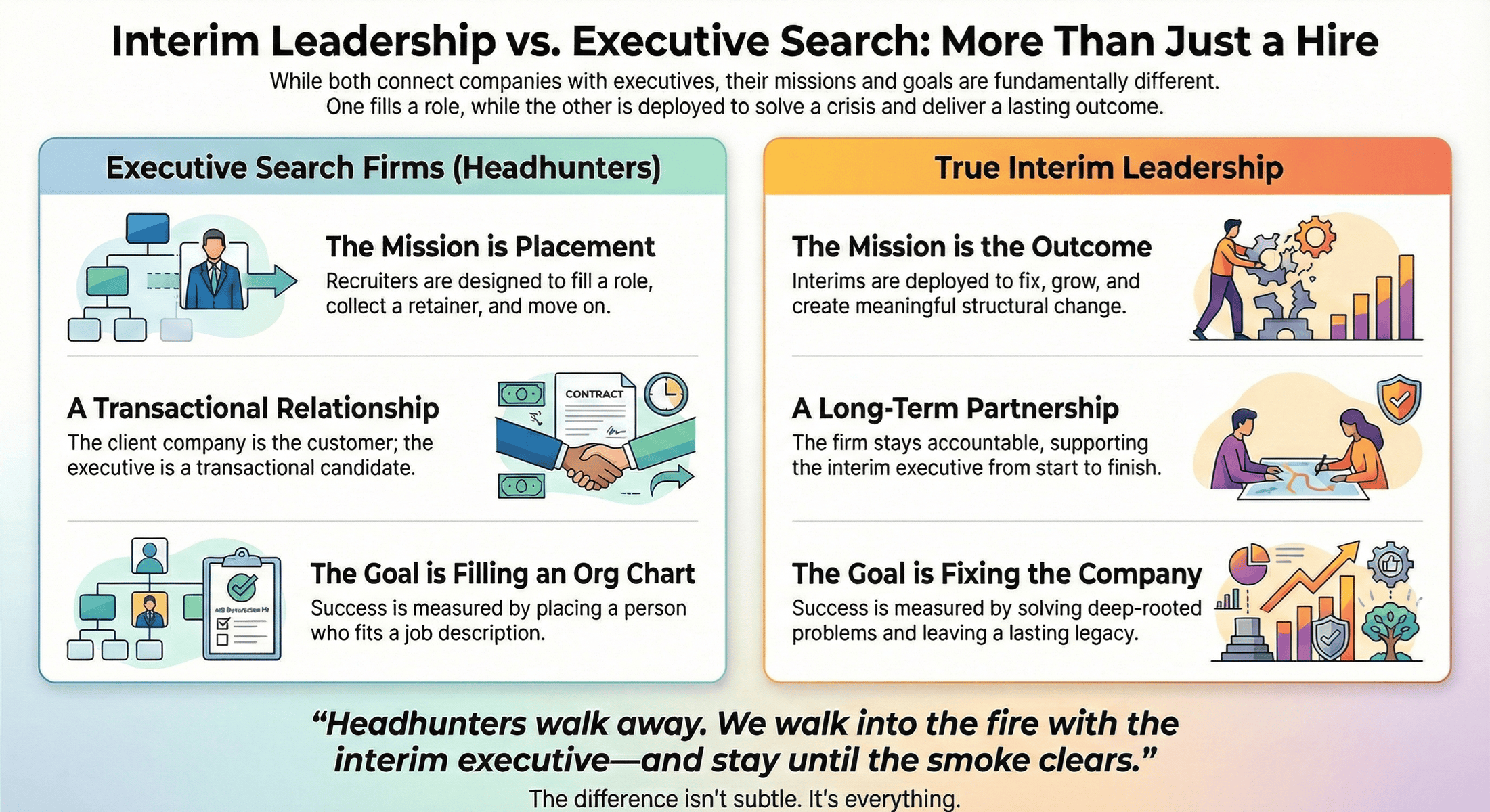
1. Executive Recruiters Place – and Then It’s Over. InterimExecs Stays.
Executive search firms are designed to fill permanent roles. Win the mandate. Collect the retainer. Find candidates, finalists, place someone. And then move on to the next retainer. Once the executive is placed, the recruiter moves on. Sayonara. Arrivederci. Ask 100 headhunters who the customer really is, and 100 will say: the client company paying the retainer is the customer. Duh! They pay the bills!
The executives? They’re transactional; they come and go. Maybe they become a friend, certainly the recruiter hopes the newly placed executive will hire them. But let’s face it: a retained search is a relationship that is periodic, optional, lightweight.
InterimExecs?
We’re there from start to finish of the gig — accountable, responsible, on the hook for the interim’s success.
It’s our contract.
Our relationship.
Our reputation.
We remain accountable. We’re part of the engagement.
In interim leadership, our work doesn’t end at placement – that’s when the real work of execution begins.
That’s not executive search.
That’s true interim leadership.
Oh, and if you want to ask us who our customer is? At InterimExecs our answer is: it’s the RED Team executive who proves themselves time and again. We love our clients, all the organizations that show up for effective leadership fast. But most companies that need interim help hope it’s a one-and-done – and if the work is done right, it is! They can sail off into the sunset, happy and fulfilled.
But us, and our executives? We’re together for the long haul.
2. Interim Leaders Prove Themselves Over and Over.
A recruiter is incentivized to place someone once. Maybe twice if they switch jobs.
But true interim leaders? They are a different breed entirely. Their professional identity is built on repeated deployments into tough, complex, high-stakes situations. They move from company to company, tackling turnaround, transformation, crisis, rapid growth – whatever the toughest item on the checklist happens to be.
Big executive search firms deputize junior staff to work with interim executives. It makes sense in their world because they are attempting to process thousands of potential interims, far more than any senior partners could ever meet, in addition to the far more important goal for them of shmoozing all of their clients and winning more retainers. So the juniors manage and juggle all of the expert executive interim leadership.
These are juniors learning headhunting who have never:
- run a business
- met payroll
- hired and fired
- won or lost a market
- led through crisis
- lived through a bust
- had to perform under pressure at the top of the house
Yet they’re the ones tasked with managing executives who’ve done all of the above.
That’s not a partnership, it’s a mismatch.
An interim leader needs a peer. A sounding board. Someone they can vent to. Someone who gets it. Who’s been there before, on the same front lines, faced the same situations in their own gigs.
That’s not a quota-driven recruiter.
That’s a partner.

3. Interim Leadership is Not Transactional.
During my call with the RED Team leader managing the crisis, I shared something deeply personal. One of our closest friends essentially drank himself to death. He’d been an alcoholic since age 9. His widow is like family to us. Their children — now grown — are my unofficial niece and nephews. When I talk to them, I think about their father’s best moments, and I tell them I love them. A lot.
I told the executive this because he had to fire the heir apparent. You can have compassion for someone’s hard home life and still know that the right and necessary thing to do is protect the company, protect the people, and protect the young woman who was hurt.
This is exactly why companies don’t search “interim executive vs executive search” just as a theoretical comparison. They search for it when something real is breaking. When they need someone who has been there. When they need someone who can find order amidst chaos.
This is also why RED Team interim leaders succeed: they are built for the emotional, operational, and cultural turbulence that permanent hires may never have faced.
Recruiters fill jobs.
Interims fix companies.
4. Interims Change More than the Org Chart.
I told the executive about one of my proudest moments with InterimExecs: the Miami Tribe of Oklahoma came to us needing leadership for their extensive portfolio of companies. Tribal leadership shared with us that the CEO we placed had changed the trajectory of their entire community for generations to come.
He helped unlock billions in revenue.
He helped secure their future.
That’s not a hire. That’s a legacy (you can watch the video from the Miami Tribe).
That’s what interim leaders do.
So, What’s the Fundamental Difference?
It’s simple:
- Executive search firms place résumés. InterimExecs deliver outcomes.
- Executive recruiters fill roles. Interim leaders fill voids.
- Headhunters walk away. We walk into the fire with the interim executive — and stay until the smoke clears.
So when search firms say they “also do interim executive work,” I smile. Because unless you’ve sat where our executives sit… unless you’ve fielded the call about misconduct… unless you’ve helped a PE-backed company navigate crisis… unless you’ve supported an interim CEO in the hardest moments…
You’re not doing interim.
You’re doing search.
And the difference isn’t subtle.
It’s everything.