847.849.2800
 Contact

Interview Framework
4 Questions Every Company Should Ask an Interim Executive
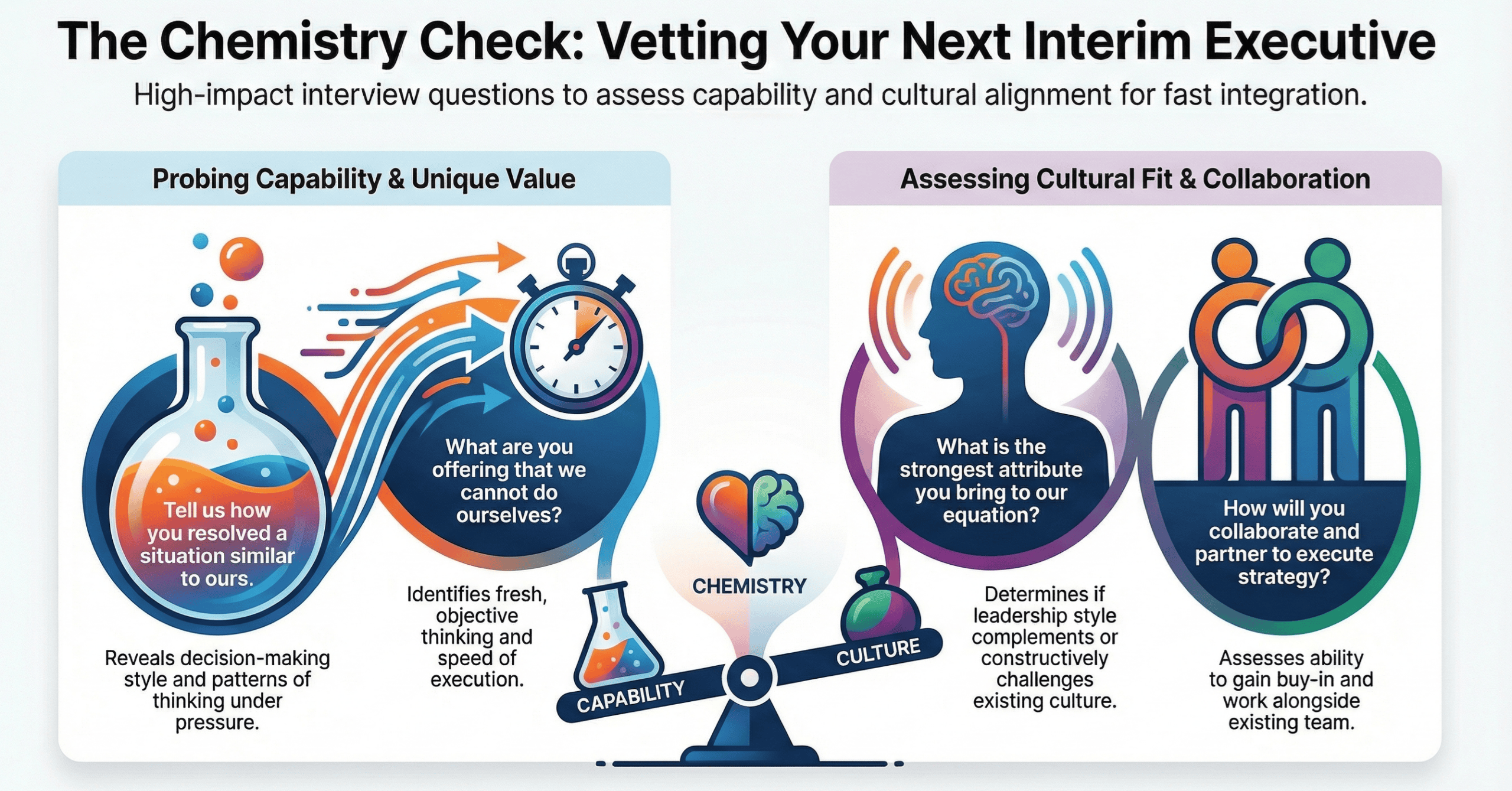
- Tell us how you resolved a situation similar to ours?
Evaluate relevant experience and the executive’s approach to solving complex business challenges.
- What are you offering that we cannot do ourselves?
Understand the unique expertise and outside perspective the executive will bring on day one.
- What is the strongest attribute you bring to our equation?
Assess leadership style and how an executive complements your existing leadership team.
- How will you collaborate with the board and partner with our team to execute strategy?
Explore an executive’s communication style and approach to driving results.
At InterimExecs, we’ve spent years developing a proven methodology for matching companies with experienced interim executives. While skills, experience, and track record matter, one factor consistently rises to the top of the list: chemistry.
Whether the interim executive will be working with a private equity fund, a company owner, a board, or an existing management team, alignment and trust are essential. Once we recommend an executive—or team—tailored to a company’s needs, the next question almost always follows:
“What should we be asking in the interview to know if this is truly the right fit?”
Below are several targeted interview questions designed to help you assess both capability and chemistry—so you can move forward with confidence.
1. “Tell us how you resolved a situation similar to ours.”
A tight alignment between an executive’s experience and the organization’s immediate challenges is critical. Career interim executives have typically worked across industries, company sizes, and complex situations.
By asking about parallel experiences—both successes and failures—you gain insight into:
- How the executive approaches problem-solving
- Their decision-making style under pressure
- The tangible value they can deliver in your specific situation
Past performance may not guarantee future results, but it does reveal patterns of thinking and execution.
2. “What are you offering that we cannot do ourselves?”
This question gets to the heart of why organizations engage interim leadership in the first place.
Boards and owners often seek interims to:
- Introduce fresh, objective thinking
- Break through growth barriers
- Address urgent operational or strategic roadblocks
A strong interim executive should clearly articulate what differentiates them, how their experience, perspective, and speed of execution allow them to add value immediately.
3. “What is the strongest attribute you bring to our equation?”
Beyond skills and experience, cultural fit matters.
This question helps you assess:
- How the executive will integrate with your existing leadership team
- Whether their leadership style complements—or constructively challenges—your culture
- If they can stabilize, elevate, or reset the corporate climate when necessary
The right interim may reinforce what’s working—or deliberately shake things up to drive results.
4. “How will you collaborate with the board and partner with our team to execute strategy?”
Interim executives are brought in to create impact quickly. They enter engagements to:
- Make focused, high-impact changes
- Execute a clear plan
- Leave the organization stronger than they found it
Their ability to collaborate with the board, gain buy-in from management, and work alongside employees is essential. Just as important: companies must be clear about how much authority they are willing to grant the interim executive to lead effectively.
Remember: The Interview Is a Two-Way Conversation
While companies are evaluating interim executives, the reverse is also true.
Seasoned interims are selective. They listen closely to the questions being asked—and often interpret them as signals of whether the organization is truly ready to support and implement meaningful change.
And finally, when both sides know the fit is right, the most powerful question of the day becomes:
“When can you start?”
Need help now?
Explore InterimExecs RED Team
Contact us today for a confidential conversation about your needs and how the right interim executive can accelerate results.
Read More
Frequently Asked Questions
An interim executive interview should focus on immediate business needs, comparable assignments, speed of execution, and measurable outcomes. Because the engagement is temporary, the candidate must demonstrate how they will assess the situation, establish authority, and begin producing results without a lengthy onboarding period. Here’s a list of 4 key questions to ask in the interim executive interview.
Expect specific examples rather than general leadership claims. True interim executives like the vetted members of InterimExecs RED Team are driven by the challenge and have a strong track record of success across industries, operations, and challenges. They are well-versed in explaining the situations they have encountered, the decisions they personally made, the results they achieved, and what they learned. Their answers should also demonstrate adaptability, sound judgment, and comfort being accountable for outcomes.
Ask how the candidate has earned trust, handled resistance, and worked with established leadership teams in previous assignments. The best interim executive may not mirror the existing culture, but should be able to work within it, challenge it constructively, and build alignment around necessary changes.
Warning signs include vague answers, an excessive focus on job titles rather than results, limited experience completing interim assignments, and an inability to describe measurable outcomes. Be cautious if a candidate appears to be seeking permanent employment, avoids accountability, or talks mainly about recommendations rather than execution. Those are not true interim executives.
Before the engagement begins, the organization and executive should agree on the scope, objectives, decision-making authority, reporting relationships, resources, success metrics, and expected duration. They should also establish how progress will be communicated and how responsibilities and knowledge will be transferred at the end of the assignment.