847.849.2800
 Contact


Selling a business is a complicated process that starts long before the “for sale” sign goes up. Here are the traps along the way when unprepared owners falter, leaving millions on the table, and the easiest way to fix each mistake.
Too many founders treat selling their company like listing an old couch on Facebook Marketplace: slap on a hopeful price tag, cross their fingers, and assume someone will show up with a briefcase of cash.
Sadly, it doesn’t work that way.
We asked the interim CEOs, CFOs, COOs, CIOs, and CMOs on our RED Team, leaders who have collectively taken dozens of companies to exit, a simple question: What does it actually take to get to a sale?
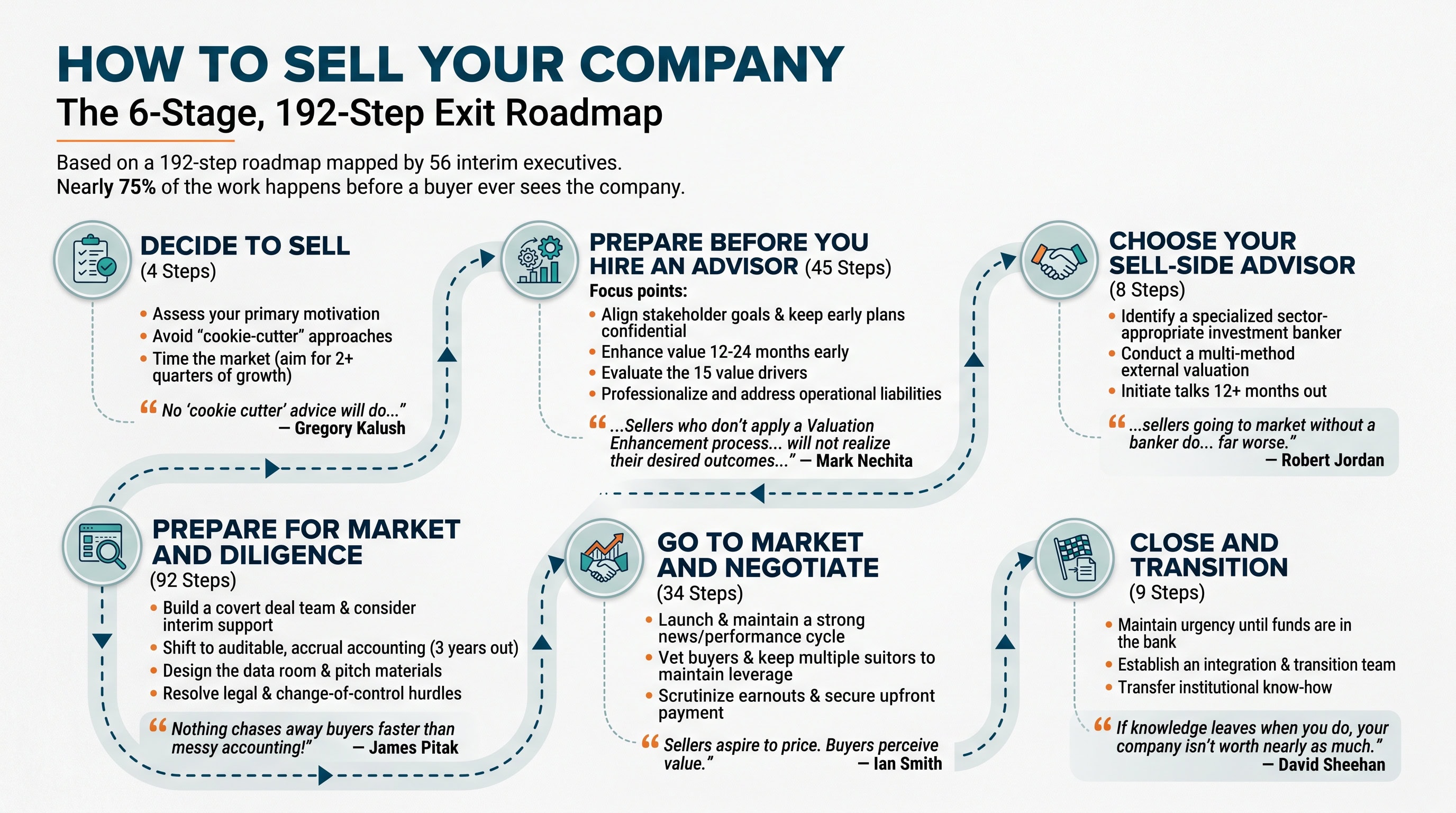
The answer was a complicated, overwhelming 192-step roadmap with significant land mines along the way. Here, we look at the seven costliest mistakes business owners make when selling their company and offer solutions for each.
Mistake 1: Leaving Millions on the Table
You run your business to minimize taxes, running personal perks through the ledger and ignoring sloppy margin leaks. That might feel clever with your accountant in April, but it’s catastrophic at the deal table.
Valuations are driven by multiples of earnings. With private equity willing to pay 10x EBITDA for the right company, every $100,000 in unoptimized earnings or unrecouped margin strips $1 million cash out of your pocket at close.
If you haven’t aggressively audited your operations, killed deadweight product lines, and normalized earnings 18 to 24 months out, you’re leaving cash on the table.
The Easy Fix
Bring in a fractional CFO 12 to 18 months before hitting the market. Every company can afford at least a few hours’ worth of time from a rock star CFO who has bought and sold other companies. They know how to normalize earnings, eliminate phantom costs, plug margin leaks, and ensure your company commands top dollar from eager buyers.
Mistake 2: Thinking Your Business Can Survive Without You
If you’re the chief rainmaker, head problem-solver, and the only person with the password to the company vault, you haven’t built a saleable business; you’ve built a company that won’t survive if you get hit by a bus. And it won’t command top dollar from a buyer who is worried that you ARE the business and the business is you.
If buyers fear that clients will walk out the door the day you leave, the buyers are likely to walk as well. Or, offer much less than you believe the company is worth.
The Easy Fix
Bring in a fractional CEO to run the company and an interim COO to ramp up production while you focus on the exit. It’s the easy way to prove to buyers that the business reliably generates cash without your constant presence.
Mistake 3: Presenting “Shoebox Accounting”
Nothing kills a deal faster than messy, unaudited, cash-basis books.
A strategic buy shows up wtih forensic teams trained to treat financial discrepancies like blood in the water. If your revenue recognition is fuzzy, your inventory accounting is guesswork, or your personal truck lease is still buried in OPEX, buyers don’t just ask for explanations; they retrade. In M&A, uncertainty is never priced in your favor; it is deducted directly from your payout.
The Easy Fix
Engage a fractional CFO to transition your books to GAAP-compliant, audit-ready financials, build bulletproof three-statement models, and construct a diligence-proof Quality of Earnings report before the buyer’s forensic team arrives.
Mistake 4: Catching “Transaction Drag” and Crashing the Core Business
Selling a company is a full-time executive grind that easily sucks 30+ hours a week out of your schedule.
Here’s the trap: you and your leadership team get so buried in virtual data rooms, diligence requests, and banker calls that you take your eye off the wheel. Sales drop, Q3 targets get missed, and pipeline velocity stalls while you’re under LOI.
Buyers track that real-time dip. The moment performance slips, they announce: “Well, the business isn’t tracking to forecast, so we need to discount the offer by 20%.”
The Easy Fix
Install an interim CEO or COO to helm daily operations so your existing C-suite stays laser-focused on hitting quarterly targets. It also reinforces the idea that the company will thrive after you’re off to the beach to count your money.
Mistake 5: Going it Alone
Going to market without experienced deal veterans is like representing yourself in court against a team of corporate litigators. An experienced team will find you at least two bidders and get them bidding against one another. That competitive tension is the only lever that forces buyers to bid up; take away the threat of another suitor, and you lose all your leverage.
The Fix
Partner with an interim CEO who has navigated dozens of successful exits to vet prospective buyers, coordinate your bankers and legal counsel, run competitive tension, and ensure you don’t get bullied into bad terms.
Mistake 6: Thinking of an “Earnout” as Real Money
If a buyer offers you $30 million structured as $12 million in cash at close and $18 million in an earnout tied to aggressive three-year milestones, you didn’t sell your business for $30 million. You sold it for $12 million, plus a lottery ticket.
Once a buyer takes the wheel, they can change marketing budgets, alter sales structures, or reallocate shared services in ways that ensure those rosy milestones are never hit. Worse, if your core tech or product infrastructure is a mess, the buyer will use it as an excuse to redirect funds and kill your earnout payout.
The Easy Fix
Bring in a RED Team of interims to create a company that functions so well that the buyer won’t be motivated to change it and stiff you.
Mistake 7: Getting Caught Flat-Footed on the Tech Stack and AI Narrative
Buyers no longer ask if you use technology; they ask whether your infrastructure will survive an enterprise integration and how AI will threaten or scale your margins.
If your data is fragmented across five disconnected legacy platforms, your cybersecurity is one phishing email away from catastrophe, or your tech roadmap has no clear AI integration strategy, buyers will price that technical debt directly out of your purchase price.
The Easy Fix
Deploy an interim or fractional CIO to eliminate legacy technical liabilities, establish enterprise-grade security protocols, and build a compelling, defensible technology roadmap that buyers will pay a premium to acquire.
Get the Full Roadmap
You can walk through all 192 steps, with expert commentary from 56 interim executives, in our full checklist of steps to sell your business.
Talk to Us About Your Dream Team
Tell us what you’re trying to accomplish, and we’ll match you with the right executive from the InterimExecs RED Team.
Matches in as Little as 48 Hours
Frequently Asked Questions
Our interim executives, who have taken dozens of businesses to exit, have found that the most profitable exits happen when owners spend 12 to 24 months identifying valuation gaps, diversifying customer concentration, removing owner dependencies, and cleaning up financial statements. Doing this groundwork early prevents costly retrading, accelerates due diligence, and puts you in the driver’s seat during negotiations.
Transaction drag occurs when a founder or C-suite team becomes so consumed by running the deal—answering due diligence inquiries, populating data rooms, and meeting prospective buyers—that daily operations falter. If revenue dips or milestones are missed while under a Letter of Intent (LOI), buyers get nervous and often cut their offer. Bringing in experienced interim leadership to run operations or lead the transaction prep protects core business performance and maintains deal momentum.
Ideally, formal exit preparation should begin 18 to 24 months before you plan to go to market. This timeline gives you sufficient runway to run a comprehensive valuation enhancement process, transition to auditable accrual accounting, settle lingering legal or tax liabilities, and build out a sustainable leadership team that proves the business can thrive without you.
Investment bankers and brokers are outside advisors who focus on the sale, valuing the business, marketing the deal, and negotiating with buyers. Interim executives can be engaged to work on the deal, but they also can be engaged to focus inward. Either way, they become an integral part of the C-suite. They embed directly into your leadership team to fix operational bottlenecks, clean up messy financials, build out virtual data rooms, and manage daily business performance so existing leadership doesn’t burn out. Rather than brokering the sale, an interim executive optimizes the company so the banker can command the highest possible multiple.
Getting greedy or attempting to retrade on agreed terms late in the process. Once an LOI is signed and diligence is winding down, deal fatigue sets in on both sides. Introducing unexpected demands, stalling over minor points, or trying to squeeze out extra concessions often damages trust and gives the buyer an excuse to walk away or renegotiate downwards. Aiming for a firm, fair close with clear transition terms protects the deal and ensures funds actually hit the bank.