847.849.2800
 Contact

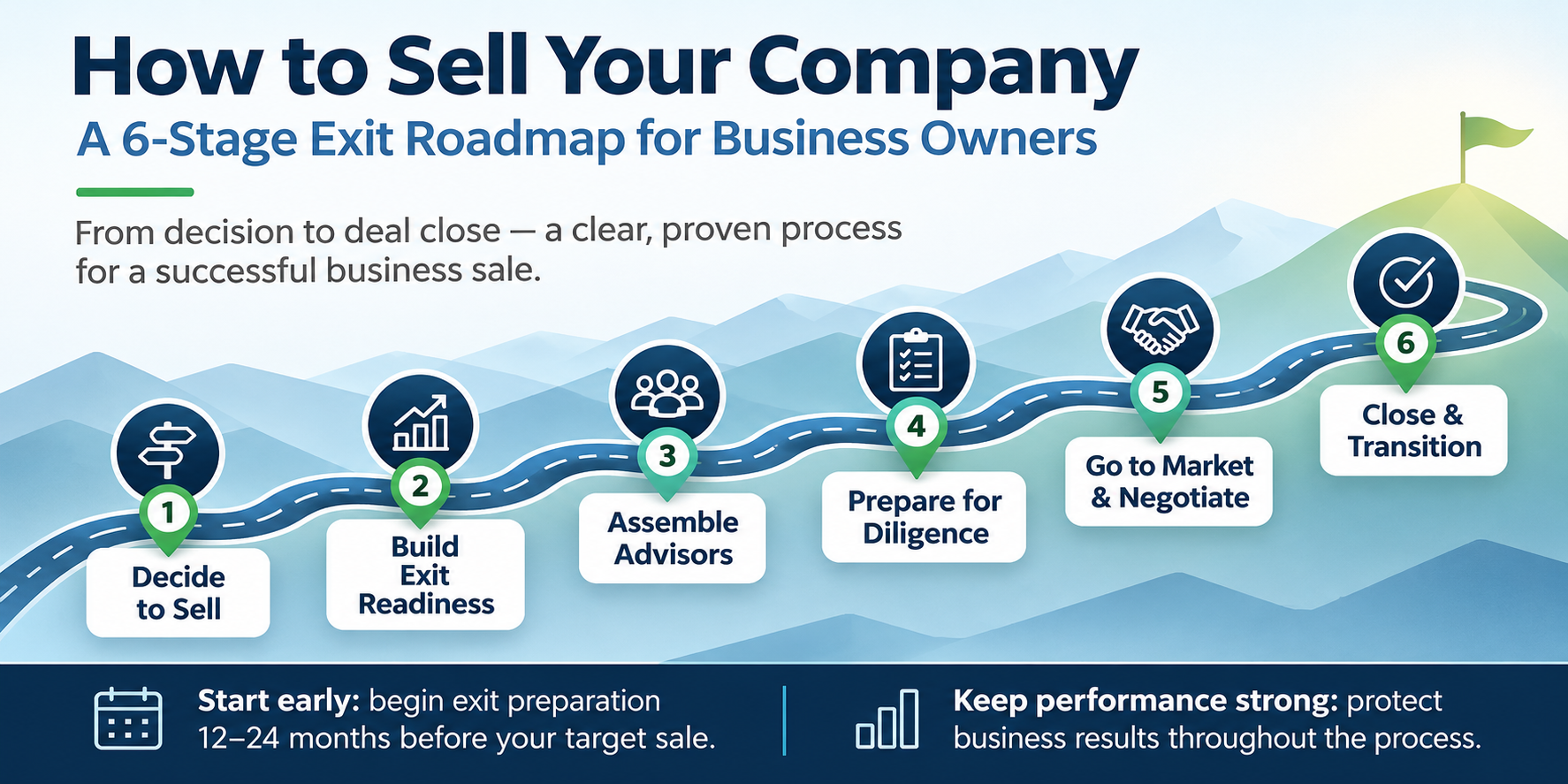
Drawing on insights from 56 interim executives, this 192-step roadmap shows that nearly 75% of critical exit work happens before a buyer ever looks at the business. To protect enterprise value, owners must run valuation enhancement 12 to 24 months early, clean up financial and operational liabilities, and lean on interim leadership to keep core operations running so transaction drag doesn’t destroy value.
When we asked our interim executives (who collectively have taken dozens of companies to exit) to flesh out a list of the steps business owners must take to get to a sale, they stepped up. Big time. Here, we lay out the steps — all 192 of them! — it takes to get to a satisfactory exit.
Stage 1: Decide to Sell (4 Steps)

This can be an emotional decision for a business founder. You need the dispassionate expertise of an outsider who has been involved in a number of successful exits. They can help increase top-line revenue, become a cheerleader for the company, build startegic partnerships, and ensure you command maximum value. Plus, turning over leadership to an outsider demonstrates to a potential buyer that the company will continue to thrive after you walk away. An interim CFO can conduct a forensic audit of how you’re spending your money and find ways to make the company more efficient.
1. Accept that every situation is different. Selling a high-growth tech platform demands a completely different playbook than consolidating an industrial services firm.
No ‘cookie cutter’ advice will do; the strategy for approaching a sale is inextricably linked to the sale situation.
— Gregory Kalush, Interim Executive
2. Get clear on your primary motivation for selling; it shapes who buys, how fast, and for how much
3. Timing the exit around market appetite and at least two quarters of verifiable upward momentum is critical.
Think TWICE about whether or not it is really the best time to sell the company. Try to take emotions and excitement out of the decision.
— Phil Morettini, Interim Executive
4. Set realistic valuation expectations based on recent comps
Stage 2: Prepare Before Hiring an Advisor (45 steps)

This stage is all about maximizing value. You need to build revenue, ensure your financials are unimpeachable, and prove the company can be successful long after you’re gone. A top-notch interim CEO can lead all of that, while an experienced interim CFO can ensure your financials are in order, and a rock-star COO can maximize operations to increase revenue.
5. Keep early deliberations confidential; a deal that falls through can trigger significant disruption.
I’ve been involved in two M&As at a single company that both didn’t go ahead. It can cause an exodus of the C-suite when you don’t want that.
— Babs Ryan, Interim Executive
6. Define the reason for selling and the outcome you want
7. Set exit goals for price, buyer type, your post-sale role, deal structure, and care of employees.
8. Decide what you hope to achieve, what you won’t compromise on, and whether it fits the market.
9. Build alignment among stakeholders early; lack of alignment is why most deals fail.
When considering a sale it is important to remember that most deals do NOT happen.
— John Zombolas, Interim Executive
10. Sketch your ideal outcome, handover, and timetable.
11. Decide how committed you are to keeping the company profitable during and after the transition.
12. Begin with the end in mind: plan the legacy for yourself, your family, and your partners.
13. Consult family members so launching a sale doesn’t start World War III.
14. Consult your board for advice and a go-ahead vote, and keep notes on where each member stands
Start Early and Raise Your Value
My experience is that sellers who don’t apply a Valuation Enhancement Process in advance of a desired sale will not realize their desired outcomes: price, timing, optimal buyer, etc.
— Mark Nechita, Interim Executive
15. Begin exit preparation at least two years before you want to sell.
16. Engage a business advisory consultant several quarters ahead to run a valuation enhancement process.
17. Run a Buyer’s Assessment at least 18 months before appointing a bank, scoring 15 value drivers out of 5 each
18. Buyer’s Assessment: your story and value to customers are clear.
19. Buyer’s Assessment: industry peers see you as top 5.
20. Buyer’s Assessment: you have the highest margins in your industry.
21. Buyer’s Assessment: sales and profits are growing at 25%.
Stay Ahead
Leadership Insights for Owners, Investors & Boards
Join executives, PE sponsors, and board members who receive ideas every month from InterimExecs on transformational leadership and business growth.
22. Buyer’s Assessment: no one customer accounts for more than 5% of sales.
23. Buyer’s Assessment: the three-year horizon shows a strong, high-growth market.
24. Buyer’s Assessment: legacy products don’t dominate sales and profits.
25. Buyer’s Assessment: your top 10 managers are regarded as world-class.
26. Buyer’s Assessment: the business is not dependent on the owner.
27. Buyer’s Assessment: staff morale and engagement are high.
28. Buyer’s Assessment: current-year trading and forecast beat previous years.
29. Buyer’s Assessment: the business model produces a sustainable annuity income stream.
30. Buyer’s Assessment: accounts are audited annually by a recognized firm.
31. Buyer’s Assessment: legal contracts and filings are in good order.
32. Buyer’s Assessment: annual profits are significant (EBITDA of $10M scores a 5).
33. Sell from strength: growing revenue, a full pipeline, and strong gross and EBITDA margins.
The 12-18 months prior to the desired sale date should be a full court press to show how good the business can be.
— Doug Olds, Interim Executive
34. Review working capital 12–18 months out; excess inventory or slow collections cut proceeds.
35. Clean up lingering issues such as lawsuits and customer disputes.
36. Eliminate unprofitable parts of the business.
37. Professionalize the organization and invest where needed.
Understand Your Valuation
38. Learn the basics of business finance and valuation.
39. Value the company three ways: comps, unlevered cash flows, and assets.
40. Prepare a pro forma valuation of outcomes, including tax impact.
41. Ask your tax team about carryforwards and tax preferences that could change value and the buyer pool.
I once had a banker value a company at $10 million based on cash flows; however, the company had more than $100 million in transferable tax preferences.
— Kelly Haggerty, Interim Executive
42. If it’s a carve-out, have a finance and operations expert review the approach and timeline up front.
43. Understand how buyers will value you: ARR multiples, SaaS vs. one-time sales, size bumps.
44. Expect PE buyers to value on an EBITDA multiple, not revenue alone.
45. Be realistic about your value and know what justifies it against competitors.
Everything else is extra. If you have no one buying you or offering to buy you, the rest is meaningless.
— Keith Brooks, Interim Executive
Plan for the Workload and Your First Advisors
46. Recognize the sale will consume significant time from key executives; consider engaging experienced interim executives to supplement the C-suite and keep operations running smoothly.
47. Hire external legal counsel with M&A and industry experience.
48. Plan on experienced transaction counsel; they pay for themselves.
49. Let the people you do business with know you’re open to selling, without naming a number.
Stage 3: Choose Your Advisors (8 Steps)
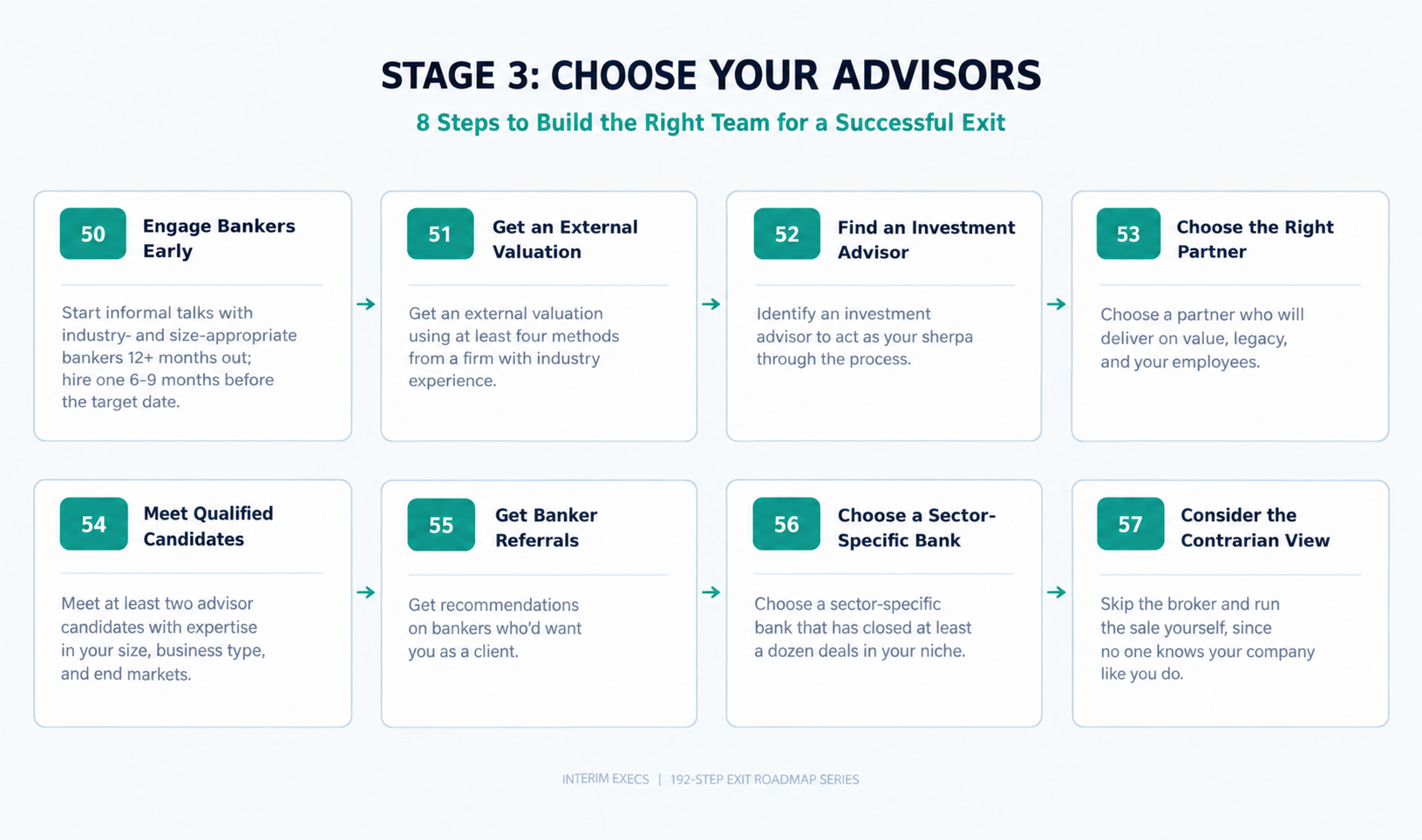
This stage is all about relationships. Bringing in an interim CEO who has bought and sold other companies gives you access to their network of the best bankers, lawyers, and advisors in your market niche.
50. Start informal talks with industry- and size-appropriate bankers 12+ months out; hire one 6–9 months before the target date.
51. Get an external valuation using at least four methods from a firm with industry experience.
52. Identify an investment advisor to act as your sherpa through the process.
53. Choose a partner who will deliver on value, legacy, and your employees.
54. Meet at least two advisor candidates with expertise in your size, business type, and end markets.
55. Get recommendations on bankers who’d want you as a client.
It’s important to have an investment banker engaged. I don’t think sellers going to market without a banker do any better. Likely, they do far worse.
— Robert Jordan, CEO, InterimExecs
56. Choose a sector-specific bank that has closed at least a dozen deals in your niche.
57. The contrarian view: skip the broker and run the sale yourself, since no one knows your company like you do.
Stage 4: Prepare for Market and Diligence (92 steps)

Engaging an interim CFO is critical at this stage. The numbers have to tell a relatable, accurate, and honest story to potential buyers. If you can’t afford a full-time interim CFO, engage a top-tier fractional CFO. Every company can afford at least a few hours of a CFO’s time on a part-time basis.
58. Choose a process and commit to it; how you navigate diligence decides its length, cost, and outcome.
59. Pick the format (such as a tender or an auction) based on your size and counsel.
60. Keep watch for a buyer before you technically go to market.
61. Push the transaction along relatively quickly.
62. Consider creative exits such as an ESOP.
Data shows that [an ESOP] outperforms comparables because it creates a culture of thinking like an owner.
— Jennifer Crews, Interim Executive
Build the Deal Team and Communication Plan
63. Decide who on the management team is privy to the process.
Pay attention to optics here; if staff see a number of private meetings and hushed conversations, that will impact morale.
— Joshua Katz, Interim Executive
64. Decide who is on the prep and sales team, and who won’t know until the sale is final.
65. Set up an NDA policy, signature form, and inner-circle process.
Your true assets are likely your people.
— Buddy Willard, Interim Executive
66. Create a covert internal war room to handle short-listed buyers.
67. Extend the inner circle to people who can support buyer diligence.
68. Agree on an update cadence with key stakeholders.
69. Map stakeholder groups and what each will hear, and when.
70. Prepare media and stakeholder messaging, assuming the news will leak.
71. Communicate with staff and stakeholders with careful timing and cadence.
72. Talk with your employees as appropriate; you need their support, and it’s better if they hear it from you.
73. Be transparent with leadership, advisors, and bidders.
74. Bring in outsourced people to run day-to-day operations while management focuses on the sale.
75. Consider an interim executive to fill critical gaps, since sales take longer than expected.
Selling a company can take longer than expected, so seriously consider hiring an interim exec to fill any critical gaps until the buyer can decide how best to proceed.
— Jeremy Sanders, Interim Executive
76. Engage the full resources of your board and delegate as little externally as possible.
Get Records, Operations, and People in Order
77. Clean up tax returns and financial statements three years out, removing owner discretionary expenses.
Nothing chases away buyers faster than messy accounting!”
— James Pitak, Interim Executive
78. Move to auditable financial systems.
79. Have at least the previous two years audited.
80. Organize business records.
81. Declutter: move personal assets and irrelevant expenses out, ideally two years before.
82. End family discounts and privileges that drag on margins.
I looked at one prospect where the seller gave their mother free rent in an assisted living community. I walked away because I didn’t want to deal with the PR of evicting her.
— Frank Tsai, Interim Executive
83. Document accounting policies and correct any noncompliance.
84. Document your revenue recognition policy.
85. Prepare your chart of accounts.
86. Detail the balance sheet: deferrals, accruals, debt, related-party transactions, leases, AP.
87. Keep a fixed asset register that reconciles to the balance sheet.
88. Document credit terms and the allowance for doubtful accounts.
89. Detail any factored receivables.
90. Gather three years of federal, state, and local tax returns.
91. Document investment tax credits used.
92. Show payroll taxes are current.
93. List systems and providers, with costs and contract terms.
94. List all assets: tangible, intangible, and intellectual property.
95. Perform a market analysis with five-year projections.
96. Build a rigorous, repeatable way to measure the sales pipeline.
97. Inventory SOPs and fill gaps where knowledge sits with a few people.
98. Prepare org charts with roles and responsibilities.
99. Identify key employees and sign retention agreements with flight risks.
100. Work with HR on a plan for affected employees, compensation obligations, and fair selection criteria.
101. Assess team skills with a skills matrix and identify critical personnel.
102. Assess the technical debt you’ve accumulated.
103. Audit technology and product assets for scalability, security, and data compliance.
104. Don’t underestimate preparation; it’s what makes the process smooth.
Build the Financial Model
By creating these, you will force yourself to think of the business as an ‘investor,’ putting yourself in their shoes.
— Vini Meirelles, Interim Executive
105. Produce monthly income statements, balance sheets, and cash flow statements.
106. Provide at least two years of monthly statements to show seasonality.
107. Move to accrual accounting.
108. Adjust for non-recurring expenses and revenue.
109. Organize other historical data: volumes, clients, contracts.
110. Report inventory and production volumes by product line.
111. Break out profit and loss by product or service line.
112. Show recurring revenue as its own category and grow its share.
113. Prepare financial forecasts and projections.
114. Build scenarios that show your upside.
115. Formalize best, likely, and worst cases.
Understand that the buyer will not pay for value enhancement that they bring post-close.
— Jim Long, Interim Executive
116. Plan financing needs for each scenario.
117. Set an ambitious valuation target to stretch management.
Tell the Story
119. Do due diligence on yourself as if you were the buyer.
120. Document your short- to mid-term improvement plans.
121. Build a compelling, defensible story for the next three years.
122. Make the growth story imagine life beyond completion.
123. Craft an investment narrative, not an asset list.
First and foremost, it’s the story, not the assets, that investors need to understand.
— Ron Herardian, Interim Executive
124. Describe why investing in you beats the alternatives.
125. Tell how the company came to be and why demand will create future prospects.
A company is not just spreadsheets, financials, and a data room.
— Ralph Shayne, Interim Executive
126. Highlight the team.
127. Put a value on any process of yours that would lift a buyer’s profitability.
128. Estimate the value of AI in your current or future roadmap.
Whether tech-heavy or not, all buyers will expect AI to be part of the current company or future product roadmap.
— Amy Mosser, Interim Executive
129. Make a pitch deck.
130. Prepare a company brochure for roadshows.
131. Go beyond the CIM with a video for each preferred buyer.
This is your life’s work. It can’t be summarized merely in a book.
—Ian Smith, Interim Executive
Set Up the Data Room
131. Start early; gaps in the data raise the buyer’s perceived risk.
133. Appoint a Data Steward before diligence.
134. Begin the data room inventory well before you need it.
135. Set up the data room using your broker’s templates.
136. Prepare answers to the top 50 buyer FAQs.
137. Work out why a buyer would want to own your business.
The data room and due diligence are like rowing: You look backward while you move forward.
— Jan-Patrick Schmitz, Interim Executive
138. Build the data room and pitch materials in-house.
Clear Legal Obstacles
139. Organize and correct governance documents.
140. Resolve sale-stoppers: owner agreement, signing authority, liens, unfiled taxes.
Have ALL skeletons dealt with or expensed beforehand; there’s no happier buyer than someone who knows where bottom is.
— Anthony Hartman, Interim Executive
141. Review contracts 12 months out for change-of-control terms and renew expired ones.
142. Fix integration obstacles: contract assignability, leases, warranties, refunds.
143. Use a big-firm lawyer to document the deal, watching reps and warranties.
Build the Buyer List
144. Know the metrics buyers will put value on.
145. Get the “who” right: buyer type, your representation, who manages the process.
146. Develop a diverse target list of strategic and financial buyers with your banker.
147. Shortlist prospects you can approach in confidence.
Prepare for the Quality of Earnings Review
148. Provide general ledgers at year-end and for the latest period.
149. Provide AR agings by customer, including write-offs.
Stage 5: Go to Market and Negotiate (34 steps)

An experienced interim CEO who has bought and sold other businesses can lead negotiations and take the emotion out of the conversation for the owner. For the buyer, an outside CEO demonstrates that the company can continue to perform long after the founder has left. In addition, a fractional CFO who can walk a potential buyer through your financials is worth every penny when it comes to negotiating a deal. Finally, an interim COO who has ramped up revenue can be instrumental in maximizing the sale price. At 10X price to EBITDA, every additional $100,000 puts a million bucks in your pocket!
150. Operate with urgency once launched, because time kills deals.
Time delays often favor the buyer as it provides more time for negative events to occur.
— Doug Olds, Interim Executive
151. Keep a good news cycle going: watch results against budget and hit your projections.
152. Actively manage every “when” until closing is certain.
153. Have your broker gauge appetite and get prospects under NDA.
154. Run a roadshow with prospective buyers at an offsite location.
155. Collect first-round bids (indications of interest) and shortlist a small group.
156. Notify bidders of their status and set up diligence with the winners.
157. Expect a buyer who knows your business to make an offer.
158. Know the strengths and weaknesses of your financial statements before negotiating.
159. Trust your gut on who’s a real prospect and who’s a tire kicker.
Diligence and Finalists
160. Run diligence Q&A through the data room and keep site tours small.
161. Involve your legal team before the LOI meeting.
162. Research each buyer’s objectives and history, and prepare a targeted message for each meeting.
163. Showcase the culture and team spirit that will drive growth after the acquisition.
One of the selling points that helped put the deal over the line was the powerful work ethic, team spirit, and excellence-seeking work culture that we had built.
— Steve Hummeln, Interim Executive
164. Share engagement survey results to prove your culture is a selling point.
165. Keep at least two suitors.
It normally takes two suitors to provoke the first into a transaction.
— Owen Carton, Interim Executive
166. Run a best-and-final round through your broker.
167. Have each acquirer spell out its integration strategy.
168. Pick the offer that meets your objectives, and interview companies the buyer has acquired.
Negotiate Key Terms
169. Don’t take the first offer; it’s rarely the final one.
170. Game out offer types (cash, stock, asset-only) and which liabilities may stay with you.
171. Focus on the upfront payment at closing, since milestones rarely pay out.
172. Craft earnouts carefully, or they breed conflict when payment comes due.
[Earnouts] can be very tricky and cause a lot of angst.
— Frank Tsai, Interim Executive
173. Decide whether you or senior staff will stay on, and how earnouts might apply.
174. Negotiate your own transition role, timeline, and payout.
175. Protect any deferred payment or equity with board seats and reporting rights.
176. Make it easy for each buyer to write its board paper.
Sellers aspire to price. Buyers perceive value. It’s the buyer who writes the check.
— Ian Smith, Interim Executive
177. Aim for a fair deal, not blood from a stone
178. Don’t get greedy or retrade late in the deal.
I’ve seen many good deals fall apart because the owners got greedy in the end.
— Russ Reeder, Interim Executive
179. If you’re a public or closely traded company, make sure new stock grants during the sale don’t raise insider trading issues.
180. Plan fairly for employees who leave and clearly for those who stay.
181. Agree to terms such as the transition services agreement, guaranties, penalties, and trigger dates.
182. Agree on an update cadence and escalation process with the buyer.
183. Be prepared for the worthwhile grind; no amount of polish from fee-earners changes that.
Stage 6: Close and Transition (9 steps)
* Interim CEO to close the deal and, if needed, stay on to run the company through the transition.
* Interim or fractional CIO and CTO to oversee the integration of the tech stacks.
* Interim COO to consolidate production processes.
* Interim CFO to close the deal and file the reports.
184. Keep driving to close; the deal isn’t done until the money is in the bank.
185. Form a transition team (operations, legal, CFO) to keep the sale on track.
186. Document your know-how so it transfers to the buyer, not out the door with you.
If knowledge leaves when you do, your company isn’t worth nearly as much.
— David Sheehan, Interim Executive
187. Establish a shared vision, purpose, and values for the combined company.
188. Tell customers your intentions and keep servicing them as always.
189. Build a communication plan and timetable for customers, partners, and suppliers.
190. Build a comprehensive IT integration plan.
191. Plan how technology, processes, and teams merge into the buyer’s ecosystem.
192. Identify positive and negative synergies under different types of owners.
Creating this Exit Checklist
Our good friend, Steven Vivian, reviewed 200+ comments and proposed steps offered up by 56 expert interim CEOs, CFOs, COOs, CIOs, and CMOs to create this list.
Steve is an exceptionally accomplished investor, operator, and strategic advisor with more than 25 years of experience helping growth-oriented companies create value. Founder of Kestrel Capital Group and longtime Partner at Prism Capital, Steve brings deep expertise in private equity, leveraged finance, acquisitions, founder transitions, growth strategy and governance.
He has served on numerous corporate boards and held hands-on operating leadership roles, giving him the rare ability to combine sophisticated financial judgment with practical execution. A former Chairman of the Small Business Investors Alliance, Steve is also an Adjunct Lecturer in Strategy at Northwestern University’s Kellogg School of Management, reflecting the depth of his strategic and leadership expertise.
We needed a veteran of transaction completion who had sat at various points on all sides of the deal table, as buyer, seller, intermediary, and operating executive, to wrangle an extremely complex process.
Some of the process is malleable, but as Steve writes: “It’s a structure that makes sense to me. Basically, debate and decide whether or not to sell your company, then after the decision but before the sale process there are decisions on selection of advisors and operating executive resources, then the sell side process itself, then post-closing processes.”
You may agree with Steve, who said of all the expert opinions, “the more I got into it, the more context I saw in the steps.” One other comment from Steve struck us. He said there was near unanimity from the interims that you can’t go through a sales process without advisors and operating resources that are outside of the day-to-day operational team.
The Full List of Contributors
These 56 RED Team interim executives built the list: Adam Boris, Amy Mosser, Anthony Gargiulo Jr, Anthony Hartman, Babs Ryan, Bill Mince, Buddy Willard, Dan Weinfurter, David Esposito, David Sheehan, Dennis Cagan, Don McIsaac, Doug Olds, Frank Tsai, Gregory Kalush, Ian Smith, Jack Didinger, James Pitak, Jan Gensheimer, Jan-Patrick Schmitz, Jane Turlo, Jennifer Crews, Jeremy Sanders, Jim Long, John Racioppi, John Zombolas, Joshua Katz, Karma Israelsen, Keith Brooks, Kelly Haggerty, Kevin Coen, Kyle Murphy, Leah Bailey, Len Chermack, Lloyd A. Perlmutter, Mark Brewer, Mark Nechita, Mike Capetanakis, Narasimha Krishnakumar, Nora Baker, Owen Carton, Peter McCann, Peter Wokwicz, Phil Morettini, Ralph Shayne, Rich Bialek, Robert Jordan, Ron Herardian, Russ Reeder, Sharon Ephraim, Sri Srinath, Steve Hummel, Steve Vivian, Susan Rittscher, Vini Meirelles, and Zeeshan Kazmi.
Talk to Us About Your Dream Team
Tell us what you’re trying to accomplish, and we’ll match you with the right executive from the InterimExecs RED Team.
Matches in as Little as 48 Hours
Frequently Asked Questions
Believing that the sales process starts when an offer arrives. Nearly 75% of the actual work required to command top dollar happens 12 to 24 months before putting up the “for sale” sign. You need that time to get the books in order and maximize value. In M&A, unoptimized EBITDA doesn’t just mean lower earnings; at a 10x multiple, every $100,000 in unrecouped margin literally robs $1 million cash from your closing payout.
Ideally, 18 to 24 months before hitting the market. That runway gives you time to eliminate owner dependency, build auditable accrual financials, settle pending legal liabilities, and prove at least two consecutive quarters of verifiable upward momentum. Bringing in expert interim leaders is the fastest, easiest way to get the company’s financials in shape, prove that the company can thrive with you as its leader, and hire the right bankers, lawyers, and advisors to attract strong buyers and sell for top dollar.
Only if you want your deal to implode. Managing due diligence, data rooms, investment bankers, and legal negotiations easily takes 30+ hours a week. Focusing on the deal increases the chances core operations will slip, quarterly forecasts will be missed, and buyers will hit you with “transaction drag” discounts under LOI. The most lucrative exits happen when an interim CEO, CFO, or COO is brought in to either run daily operations undisturbed or manage transaction readiness full-time.
Uncertainty. Due diligence is designed by buyer forensic teams to find reasons to retrade your valuation. The top culprits include sloppy cash-basis books, customer concentration where one client accounts for a chunk of revenue, unscalable operations that require the owner’s daily presence, and hidden technical debt. If a buyer uncovers messy data or downward revenue variance while under exclusivity, they will deduct the cost of fixing it straight from the wire transfer at closing.
Investment bankers and brokers sell the house; interim executives fix the foundation, patch the roof, and stage every room so the banker can actually demand top dollar. Outside bankers focus outward—marketing the deal, running buyer lists, and running the auction. An interim CFO or COO embeds directly inside your C-suite to do the heavy lifting: scrubbing messy ledgers, building bulletproof data rooms, plugging margin leaks, and protecting daily revenue from slipping while you negotiate. Relying solely on a deal broker without operational muscle inside the company is how owners get blindsided during due diligence.