847.849.2800
 Contact


1. The $2 Billion Illusion: Highly profitable, 95-year-old law firm Weil, Gotshal & Manges dissolved with $2.1 billion in revenue due to the fatal failure of executive succession and governance.
2. The “Deadline” Succession Trap: Strategic handovers must be proactive and splitting authority among part-time managers and outgoing chairs dilutes accountability, paralyzes decision-making, and triggers a run on talent.
3. The Interim Emergency Bridge: In a leadership vacuum, boards have weeks, not quarters, before talent and clients flee. Seasoned interim executives can buy companies the runway needed to execute a successful long-term transition.
On October 28, 2026, Weil, Gotshal & Manges, the law firm that took Lehman Brothers, General Motors and Enron through bankruptcy, told its partners it was finished. “Following a careful review of strategic alternatives, the firm’s management committee has recommended to the partnership that the firm pursue an orderly wind-down,” Weil said in a statement reported by Reuters.
This isn’t a firm drowning in losses. Weil had about 1,200 lawyers and nearly $2.1 billion in revenue and $5.593 million in profits per partner in 2025. An adviser told Bloomberg Law the firm believes it can manage a solvent wind-down.
At InterimExecs, we’ve spent years parachuting operators into companies at moments like this. Our view is simple: business failures are management failures.
Markets shift, competitors get aggressive, but the job of leadership is to see that coming and act on it. Weil’s story shows how a long, stable tenure at the top can hide the slow buildup of strategic risk until it all hits at once.
Join Top Executives, Owners, & Investors
Sign me up to receive insights every month from InterimExecs on transformational leadership and business growth.
What Happened at Weil Gotshal: a Timeline
- December 2009: Weil elects Barry Wolf executive partner, replacing Stephen Dannhauser. Wolf is only the second executive partner in the firm’s history.
- 2013: Weil lays off 60 lawyers and cuts partner pay because it expects a “new slow-growth reality” in Big Law. Bloomberg Law reports that bet proved wrong.
- April 2024: Weil revises its partner pay system and begins early succession planning. Wolf faces mandatory retirement at 68.
- February 2025: A new governance structure adds a strategy committee chaired by corporate head Michael Aiello and two part-time co-managing partners, Ramona Nee and Jonathon Soler, each spending about 25% of their time on management.
- March 17, 2026: Nee is named Wolf’s successor, effective January 1, 2027. Wolf would keep chairing the management committee through 2027.
- Summer 2026: A group of private equity partners leaves for Paul Weiss and Simpson Thacher.
- September 2026: Aiello leaves for Cravath with five partners.
- October 22–23, 2026: Merger talks with Willkie Farr & Gallagher end as management committee members and star lawyers head for the exits.
- October 26, 2026: Nee declines the executive partner role.
- October 27, 2026: Global private equity co-head Doug Warner, a Weil lawyer since 1986, leaves for Paul Weiss.
- October 28, 2026: The management committee recommends a wind-down. AlixPartners is advising, and the firm plans to stay out of bankruptcy. Associates and staff are told they will get 90 days of pay plus year-end bonuses.
Leadership Owns the Outcome
Did we grow it as fast as we might have? Probably not.
— Barry Wolf, Executive Partner, Weil Gotshal
A 16-year tenure is long enough to shape strategy, culture, pay, promotions, and who is ready to take over. That is why accountability for Weil’s trajectory rests first with its leadership.
Bloomberg Law reported that Weil’s financial trajectory fell behind the peers now recruiting its partners. From 2008 to 2025, Weil grew revenue at half the annualized rate of competitors. In 2025, its revenue rose less than 3%, while the 50 largest firms grew more than 13%. Once ranked No. 6 in global private equity deal advice, Weil had fallen out of the top 20 by 2025.
Weil’s leadership acknowledged some of this:
- Wolf told Bloomberg Law the firm had been “a little too conservative” in lateral hiring.
- On private equity growth, he said: “Did we grow it as fast as we might have? Probably not.”
- On liability-management work, a field Weil helped pioneer that Kirkland & Ellis commercialized more effectively, he said: “We should have promoted it better. And we didn’t.”
Credit to him for the candor, but one leader is never the whole story.
Likely Factors Behind the Collapse (Our Analysis)
These factors are InterimExecs’ analysis. They draw on the reporting cited, but the causal links are not established fact. Rather, it is our inference based on more than 20 years of working with companies facing leadership gaps.
- A strategic forecast that went unrevised. The 2013 bet on slow growth shrank the firm just before demand recovered. A wrong call can be fixed. Defending it for a decade is the more serious mistake.
- Concentration in cyclical franchises. Lehman alone brought in nearly a tenth of Weil’s revenue from 2009 to 2011. When mega-bankruptcy work faded, the firm struggled to replace it, and Kirkland took the energy restructuring wave in Texas.
- Falling behind in the war for talent. Top partners can command north of $25 million a year. A culture of loyalty (“I view it as a family”) is a real asset, but it doesn’t hold for long against rivals who outbid you for your best people.
- Succession that came late and was split up. The formal process began as mandatory retirement approached. The result was part-time managing partners, a separate strategy chair, and an outgoing leader chairing the management committee for another year. Our inference: it was hard for anyone, including partners and clients, to tell who was really running the firm.
- Concentrated power. Former partners told Bloomberg Law that Aiello was widely seen as the firm’s most powerful person. When that power center left, the structure lost its anchor.
- A run on the partnership. Once departures accelerate, partners leave out of fear of being left behind. Consultant Kent Zimmermann put it this way: even successful firms get into trouble “if they can’t inspire enough confidence among their partners that the firm has a bright future.”
- No Plan B once the merger failed. The Willkie talks ended within days, and the successor-designate stepped back the same week. Our inference: no contingency leadership was ready to steady the firm.
- Fixed obligations with mobile assets. Bisnow reports Weil leases more than 830,000 square feet of office space, and an industry newsletter called the firm “light on debt but heavy on its lease obligations.” In a partnership, the assets go home every night and can leave for good.
Lessons for Owners, Boards and PE Sponsors
- Start succession early, and make it real. A plan that kicks in only when retirement forces it is a deadline, not a plan. Boards should know who could step in tomorrow, not in two years.
- Pressure-test the founding thesis. Every long-tenured leader has a worldview that once worked. Commission an outside review of strategy and performance against peers every few years.
- Watch the leading indicators. Revenue and profit lagged. The earlier warning signs were growth relative to peers, loss of key people, and departures from the leadership team. Track those first.
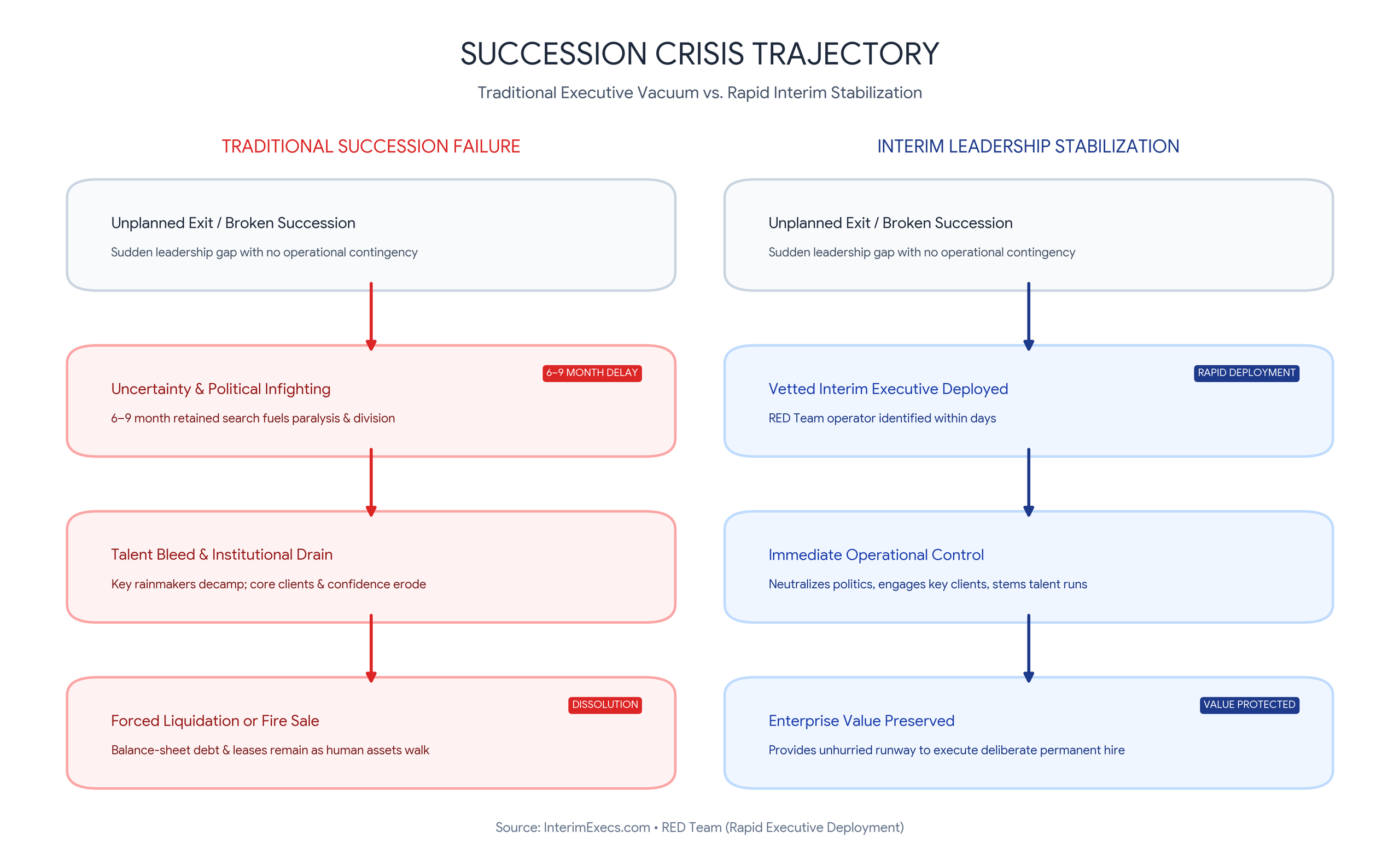
- Prepare for the moment confidence breaks. When key people start leaving, you have weeks, not quarters. That is when an experienced interim CEO, COO or chief restructuring leader with no internal politics to protect can stabilize the team, tell clients and staff the truth, and buy time for real decisions.
How InterimExecs Can Help
InterimExecs connects companies with seasoned operators, not consultants: executives who have run businesses through transitions, turnarounds and leadership gaps. Through our RED Team, we can match a vetted interim or fractional leader in as little as 48 hours and have a vetted executive on site within days.
If your company has a long-tenured leader, no clear successor, or key people starting to leave, don’t wait for your own October 28. Talk to InterimExecs about bringing in experienced leadership before the window closes.
Talk to Us About Your Dream Team
Tell us what you’re trying to accomplish, and we’ll match you with the right executive from the InterimExecs RED Team.
Matches in as Little as 48 Hours
Frequently Asked Questions
Absolute profitability can create a false sense of security. In relationship- and talent-driven organizations, enterprise value relies entirely on key operators and clients. Confidence erodes rapidly when top producers lose faith in future leadership and depart.
The firm’s approach treated succession as a pending deadline driven by mandatory retirement rather than a proactive, strategic evolution. When the transition was finally initiated, authority was diluted across a complex governance structure involving part-time managing partners, a separate strategy chair, and an outgoing leader remaining atop the management committee. Splitting leadership created organizational friction and confusion over who held true decision-making power, triggering partner defections when decisive direction was needed most.
Retained executive search typically requires six to nine months to source, vet, negotiate, and onboard a permanent CEO or managing partner. In a talent-driven crisis or active partner run, organizations do not have quarters, they have weeks. Leaving a leadership seat empty or filled by a politically constrained caretaker invites internal infighting, client defections, and competitor poaching while the search plays out. That’s when a RED Team interim executive can step in and right the ship.
An experienced interim executive becomes a part of the executive leadership team to rapidly take direct operational command. Because they are not competing for the permanent seat or seeking equity stakes, they are free from internal politics and can speak with unvarnished candor to boards, lenders, clients, and staff. They immediately establish operational transparency, stem talent runs, renegotiate critical obligations, and handle day-to-day fires so the board has the unhurried runway needed to conduct a deliberate permanent search.
Thanks to our process of vetting our RED Team executives and years of experience in this space, we can identify the right interim or fractional executive in as little as 48 hours and have someone on site in days.