847.849.2800
 Contact

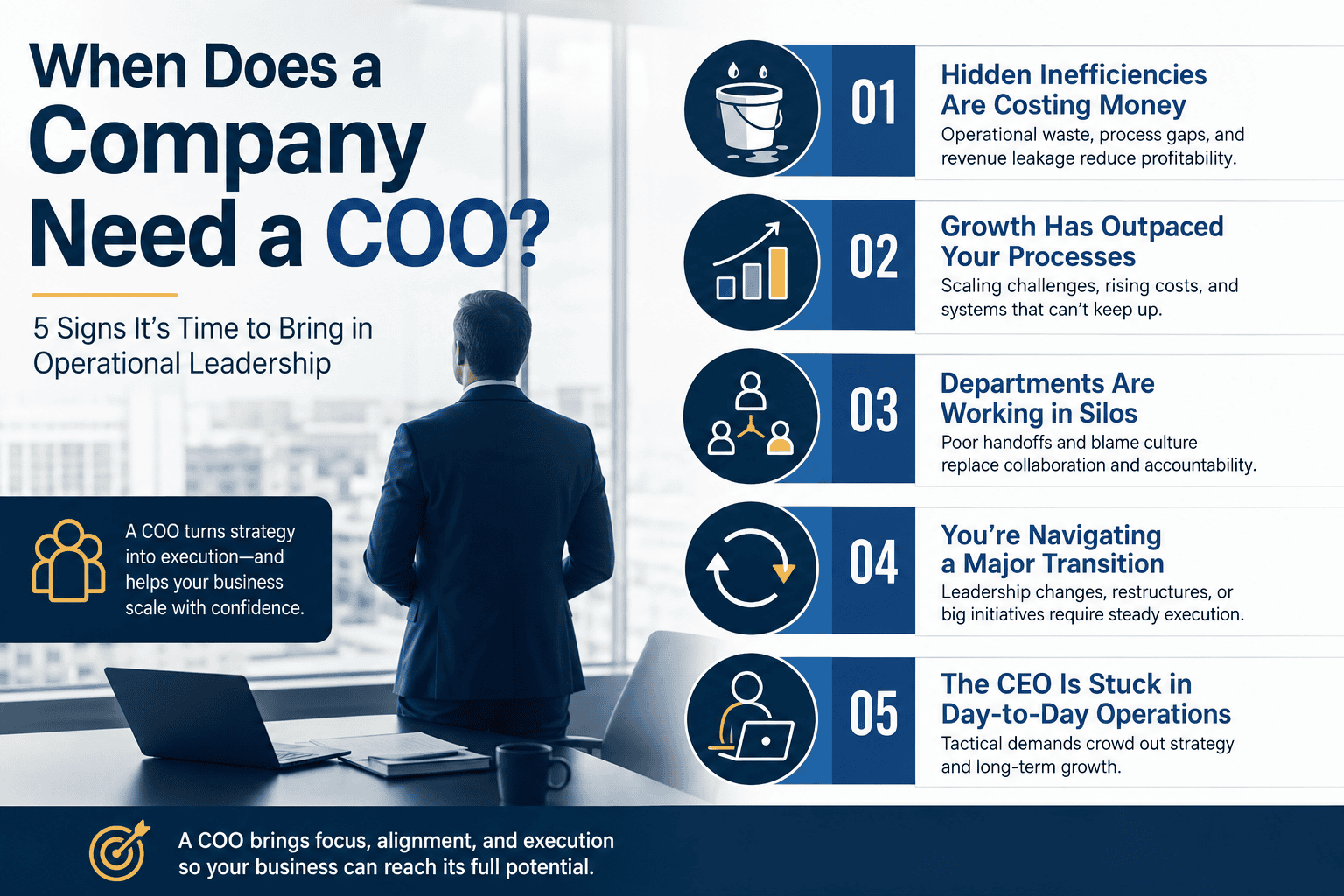
When Does a Company Need a COo?
5 Signs It’s Time to Bring on Operational Leadership
- Hidden Inefficiencies Are Costing Money
Operational waste, process gaps, and revenue leakage reduce profitability
- Growth Has Outpaced Your Processes
Scaling challenges, rising costs, and systems that can’t keep up
- Departments Are Working in Silos
Poor handoffs and blame culture replace collaboration and accountability
- You’re Navigating a Major Transition
Leadership changes, restructures, or big initiatives require steady execution
- The CEO is Stuck in Day-to-Day Operations
Tactical demand crows out strategy and long-term growth
A company typically needs a Chief Operating Officer (COO) when operational demands begin limiting growth, profitability, or execution. While founders and CEOs manage operations in the early stages, there comes a point when the business requires a dedicated executive focused on turning strategy into results.
The need for a COO is rarely tied to company size alone. Instead, it emerges when complexity increases faster than the organization’s ability to manage it.
“Running a company is hard,” says veteran COO Steve Raack. “I find that a lot of companies are very tactical rather than strategic. They’re just checking the boxes and moving forward and saying, ‘This is the way we’ve always done it,’ until you’ve got to ruffle the feathers a little bit.”
If your leadership team is constantly putting out fires, struggling to scale processes, or spending more time managing operations than driving growth, it may be time to bring in a COO.
Here are 5 signals your company may need a COO:
Read More
1. Hidden Operational Inefficiencies Are Costing the Company Money
A company may need a COO when operational inefficiencies are reducing profitability, and leadership lacks visibility into the root causes.
Raack, who grew Beautycounter 1,500 percent in his first two years as COO, calls this “leaky buckets.”
“Leaky buckets to me are typically process controls related to cash flow. I like to plug those $10,000 holes and save $70,000, $80,000, $90,000, $100,000 a month in the beginning because that helps you show value,” he says.
Signs of “leaky buckets” include:
- Revenue leakage
- Process bottlenecks
- Technology gaps
- Excess labor costs
- Inventory management issues
- Poor workflow design
- Unnecessary operating expenses
Executives focus on visible financial metrics while overlooking the operational processes driving those numbers. An experienced COO takes a data-driven approach to uncovering these “leaky buckets” and identifying opportunities to improve profitability.
Relatively small operational improvements can generate substantial financial impact within months.
Stay Ahead
Leadership Insights for Owners, Investors & Boards
Join executives, PE sponsors, and board members to receive ideas every month from InterimExecs on transformational leadership and business growth.
2. The Business Has Grown Faster Than Its Processes
A COO becomes valuable when growth outpaces the company’s systems, processes, and management capabilities.
Rapid growth creates opportunities; it also exposes weaknesses.
Processes that worked when a company had 20 employees may break down at 100. Systems that supported one location may struggle across multiple markets. Decision-making that once happened informally may require structured governance.
Common growth-related indicators include:
- Rising fulfillment costs
- Customer service challenges
- Supply chain inefficiencies
- Increasing employee confusion
- Inconsistent execution across departments
- Delayed decision-making
A COO helps build scalable operating systems that allow the organization to continue growing without sacrificing efficiency or customer experience.
3. Departments Are Working in Silos
If departments frequently blame one another for performance issues, a COO can align teams around shared processes and outcomes.
Individual employees don’t cause operational problems; poor coordination between teams does.
- Sales blames operations.
- Operations blames finance.
- Finance blames technology.
“I’d love to say that [infighting between VPs] is just disappearing. But management is a skill that not everybody comes equipped with,” says veteran COO Bill Mince.
Raack agrees. “I believe that companies are run with horizontal processes,” he says. “When those cross three or four different departments, I usually bring them up into enterprise processes that actually have handoffs. That’s typically where a lot of communication falls apart.”
Organizations with strong cross-functional collaboration consistently outperform companies trapped in siloed structures.
I usually bring them up into enterprise processes that actually have handoffs. That’s typically where a lot of communication falls apart.
— Steve Raack, InterimExecs RED Team COO
4. Leadership Is Navigating a Major Transition
Companies hire COOs during leadership transitions to maintain stability and execution momentum.
Leadership changes increase the chances of operational risk.
Examples include:
- CEO transitions
- Mergers and acquisitions
- Rapid expansion
- Organizational restructuring
- Significant technology implementations
- Turnaround situations
During periods of change, execution becomes more important than ever. A COO provides stability, continuity, and accountability while ensuring critical initiatives continue moving forward.
In many cases, an interim COO can provide immediate leadership while the organization evaluates its long-term operational needs.
5. The CEO Is Stuck in Day-to-Day Operations
A company likely needs a COO when the CEO can no longer balance strategic leadership with operational oversight.
“There is a tremendous power in reassessing what’s core and driving focus and using that to really help determine what the roles are of new items,” says COO Mike Bartikoski, “and really clearly then defining what share of resources should go there to meet the longer-term goals of the company.”
Founders and executives can become trapped in:
- Daily firefighting
- Process management
- Personnel issues
- Project oversight
- Operational troubleshooting
As a result, strategic initiatives receive less attention.
A COO creates organizational capacity by owning execution, performance management, and operational alignment. This allows the CEO to focus on vision, growth opportunities, investors, customers, and long-term strategy.
What Does a COO Actually Do?
A COO serves as the organization’s chief execution leader.
Typical responsibilities include:
- Operational strategy
- Process improvement
- Cross-functional leadership
- Performance management
- Organizational alignment
- Resource allocation
- Project execution
- Scaling operations
- Change management
While CEOs determine where the company is going, COOs ensure the organization has the systems, processes, and accountability needed to get there.
Should You Hire a Full-Time or Interim COO?
Not every company requires a permanent COO.
An interim COO can be a highly effective solution when:
- The organization needs a rapid operational assessment.
- A leadership transition creates a temporary gap.
- A major transformation initiative requires executive oversight.
- The company wants to evaluate the COO role before making a permanent hire.
- The board needs an objective third-party operational review.
Interim Executive vs. Permanent Hire
| INTERIM EXECUTIVE | PERMANENT HIRE | |
|---|---|---|
| Time to Deploy | ✓ 48 hours – 2 weeks | 3 – 6 months |
| Ramp-Up Time | ✓ Day one execution | 3 – 6 month learning curve |
| Cost Structure | ✓ No benefits, severance, or equity | Salary + benefits + bonus + equity |
| Commitment Risk | ✓ 30-day cancellation | High — severance, legal exposure |
| Objectivity | ✓ Fresh outside perspective | Subject to internal politics |
| Focus | ✓ Results-driven, defined deliverables | Long-term career considerations |
| Best For | ✓ Crisis, transition, transformation, exit prep | Long-term stable growth |
A RED Team interim COO provides immediate expertise and measurable results without the long-term commitment of a permanent executive hire.
Key Takeaways
○ A COO becomes essential when operational complexity outgrows existing leadership capacity.
○ The most common warning signs are hidden inefficiencies, siloed departments, and scaling challenges.
○ A COO frees CEOs to focus on strategy by driving execution, accountability, and cross-functional alignment.
The Bottom Line
Companies need a COO when operational complexity begins slowing growth, reducing profitability, or distracting leadership from strategic priorities.
Whether the challenge is hidden inefficiencies, rapid scaling, organizational silos, leadership transitions, or an overwhelmed CEO, a COO provides the operational leadership necessary to transform strategy into execution.
Need help now?
Request a Confidential Conversation
Explore how a rock star RED Team interim or fractional COO can parachute in to align people, process, and technology to supercharge your operations.
Read More
Frequently Asked Questions
Most companies need a COO when growth creates operational complexity that can no longer be effectively managed by the CEO alone. This occurs during periods of rapid expansion, organizational restructuring, or increased operational scale. An easy and cost effective way to test whether a COO can improve performance is to start by hiring an interim or fractional COO.
Key signs include operational inefficiencies, siloed departments, declining execution, leadership bandwidth constraints, rapid growth, and major organizational transitions.
The CEO focuses on vision, strategy, investors, and external relationships. The COO focuses on execution, operations, internal alignment, and organizational performance.
Yes. Smaller companies experiencing rapid growth or operational challenges can benefit from a COO. It is usually best to start small by hiring a part-time or fractional COO, which is the way to get a top-tier executive at a fraction of the cost of a full-time hire.
An interim COO is the best choice during leadership transitions, operational turnarounds, growth initiatives, mergers, acquisitions, or large-scale transformation projects.