847.849.2800
 Contact

Key Takeaways
○ Nonprofit mergers are accelerating, but success depends on strong, experienced leadership in the moment.
○ Interim executives bring critical financial and operational discipline, helping organizations stabilize, assess options, and execute effectively.
○ The right interim leader positions nonprofits to succeed as a stronger standalone organization or as a high-performing merger partner.
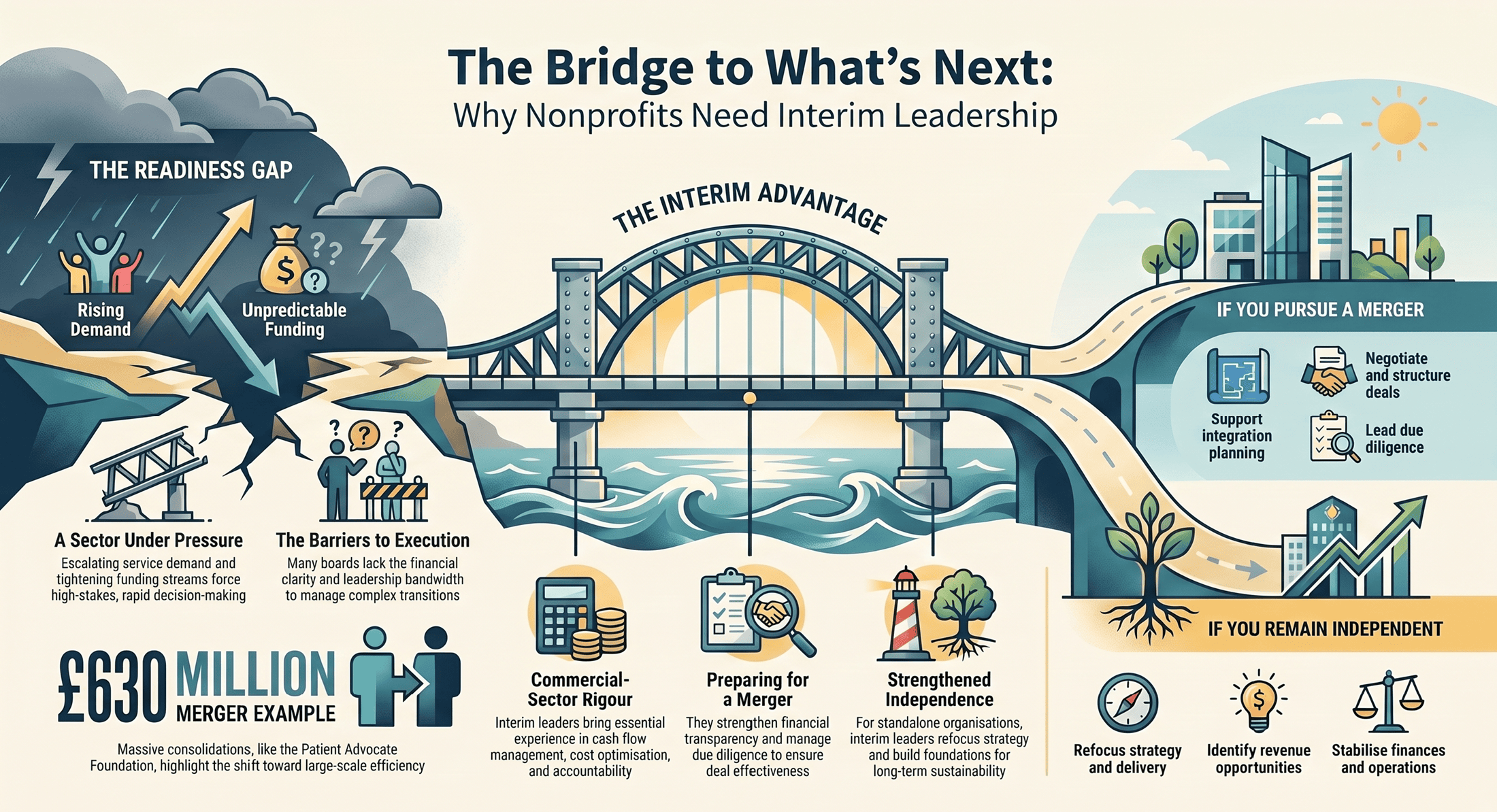
Nonprofits today are navigating a perfect storm: escalating need for services alongside shrinking, less predictable funding streams. The result is a sector increasingly in flux, with boards and executive teams under pressure to make high-stakes decisions quickly.
One solution: Merging with other like-minded nonprofits or big organizations swallowing up smaller ones.
That’s how the Patient Advocate Foundation and the Patient Access Network Foundation chose to face an unpredictable future. They have merged in a whopping $800 million deal that will launch as a consolidated financial assistance program this July. The move reflects a broader trend among nonprofits toward scale, efficiency, and coordinated impact.
But the future of nonprofits isn’t just about mergers. It’s about what it takes to make the right strategic decision and execute it well.

The Real Issue Isn’t Structure. It’s Readiness.
Whether a nonprofit is considering a merger or choosing to remain independent, the underlying challenge is the same: organizational readiness.
Too often, boards are forced to make decisions without:
- A clear, current view of financial health
- Operational alignment and efficiency
- Leadership bandwidth to manage complexity
- Experience navigating transactions or turnarounds
That’s where plans can falter. It’s not because the board chose the wrong path; it’s because the organization lacks the leadership capacity to execute either path successfully.
Interim Leadership: The Bridge to What’s Next
Interim CEOs, CFOs, COOs and other C-level interim leaders with commercial-sector experience are uniquely positioned to step into this gap.
They don’t just “keep the lights on.” They bring the expertise and objectivity needed to stabilize, evaluate, and act decisively.
Executive Advantages
What Sets Interim Leaders Apart
- Immediate Impact
They Step in quickly, providing experienced leadership during moments of uncertainty or transition. There is no need to wait months for a permanent hire.
- Financial and Operational Rigor
Interim executives bring deep experience in cash flow management, cost optimization, and performance improvement, all essential capabilities in a fast-changing environment.
- Transactional Expertise
From mergers and acquisitions to restructurings and partnerships, they understand how to evaluate and execute complex strategic moves.
- Objectivity and Independence
Free from internal politics or legacy assumptions, interim leaders provide clear, unbiased recommendations grounded in data and experience
Stronger Outcomes, Whichever Path You Choose
The value of interim leadership isn’t tied to a single outcome. It’s about ensuring the organization is positioned to succeed, regardless of direction.
If you pursue a merger, interim leaders:
- Prepare the organization for due diligence
- Strengthen financial transparency and operational alignment
- Help negotiate and structure deals effectively
- Support integration planning and execution
If you remain independent, they:
- Stabilize finances and operations
- Identify cost efficiencies and revenue opportunities
- Refocus strategy and program delivery
- Build a foundation for long-term sustainability
In both scenarios, interim leadership transforms reactive decision-making into proactive strategy.
Why Commercial Experience Matters Now
Mission-driven leadership is essential, but in times of disruption, it must be complemented by transactional and operational expertise.
Interim executives are wired for action. They can be on-site in a few days, ready to:
- Make decisions quickly with imperfect information
- Manage through financial stress and uncertainty
- Execute complex transactions
- Drive accountability and measurable results
That mindset is increasingly critical for nonprofits navigating today’s challenges.
A Defining Moment for Nonprofit Boards
The organizations that will emerge strongest in this environment are not necessarily the largest or the best funded. They are the ones that invest in the right leadership at the right time.
Mergers will continue. Independence will remain viable for many. But in both cases, success hinges on execution and execution hinges on leadership.
Need help now?
Talk to Us About Your Organization
RED Team executives can be onsite in days, assessing the need, building the plan, leading the change.
Read More
Frequently Asked Questions
Yes. Funding uncertainty and rising demand for services are driving more nonprofits to explore mergers as a way to scale impact and improve efficiency.
Interim leadership is most valuable during periods of transition, financial stress, strategic uncertainty, or when considering major moves like mergers or restructuring. Top-tier interim executives have experience and skills that may be lacking in nonprofit leadership and boards.
They help prepare financials, lead due diligence, structure transactions, and manage integration, ensuring the merger delivers intended value while serving the mission of the combined organizations.
Yes. By stabilizing operations and clarifying financial realities, interim leaders can reveal viable alternatives or strengthen the organization’s position before any decision is made.
Common roles include interim CEO, CFO, and COO, each bringing specialized expertise in leadership, finance, and operations during critical periods.