847.849.2800
 Contact

key takeaways
Financial complexity, not a specific revenue number, is the best signal. When leaders cannot confidently forecast cash, assess risk, or connect financial results to business strategy, it is time for CFO-level expertise.
Major events trigger the need. Fundraising, acquisitions, refinancing, rapid expansion, an exit, or a CFO departure may require experienced financial leadership immediately.
CFO support can be scaled to the situation. Fractional CFOs provide ongoing part-time leadership, while interim CFOs take control during urgent transitions, crises, and transformations. Permanent full-time CFOs are the answer when the organization needs full-time, ongoing financial leadership into the foreseeable future.
.
Whether you’re running a startup, scaling fast, or facing financial complexity, the question eventually comes up: Is it time to hire a CFO? This guide breaks down when to bring in a full-time, fractional, or interim CFO — and how to know which one is right for your company’s stage.
When Does a Company Need a CFO?
As a company grows, its financial decisions become more complex. Eventually, bookkeeping, accounting, and historical financial reports are no longer enough. Leaders need forward-looking guidance to manage cash, evaluate risk, allocate capital, and make better strategic decisions.
InterimExecs RED Team CFO Vic Datta, who has more than 25 years of experience as an interim CFO, says today’s CFO must be able to connect finance with operations, technology, and company strategy.
A good CFO has the skills of looking forward. They understand business drivers, they understand not only their business, but they understand their customer’s business, and they understand their competitor’s business.
— Vic Datta, RED Team CFO
The right time to hire a CFO is before financial uncertainty becomes a crisis.
Here are seven signs your company has reached that point.
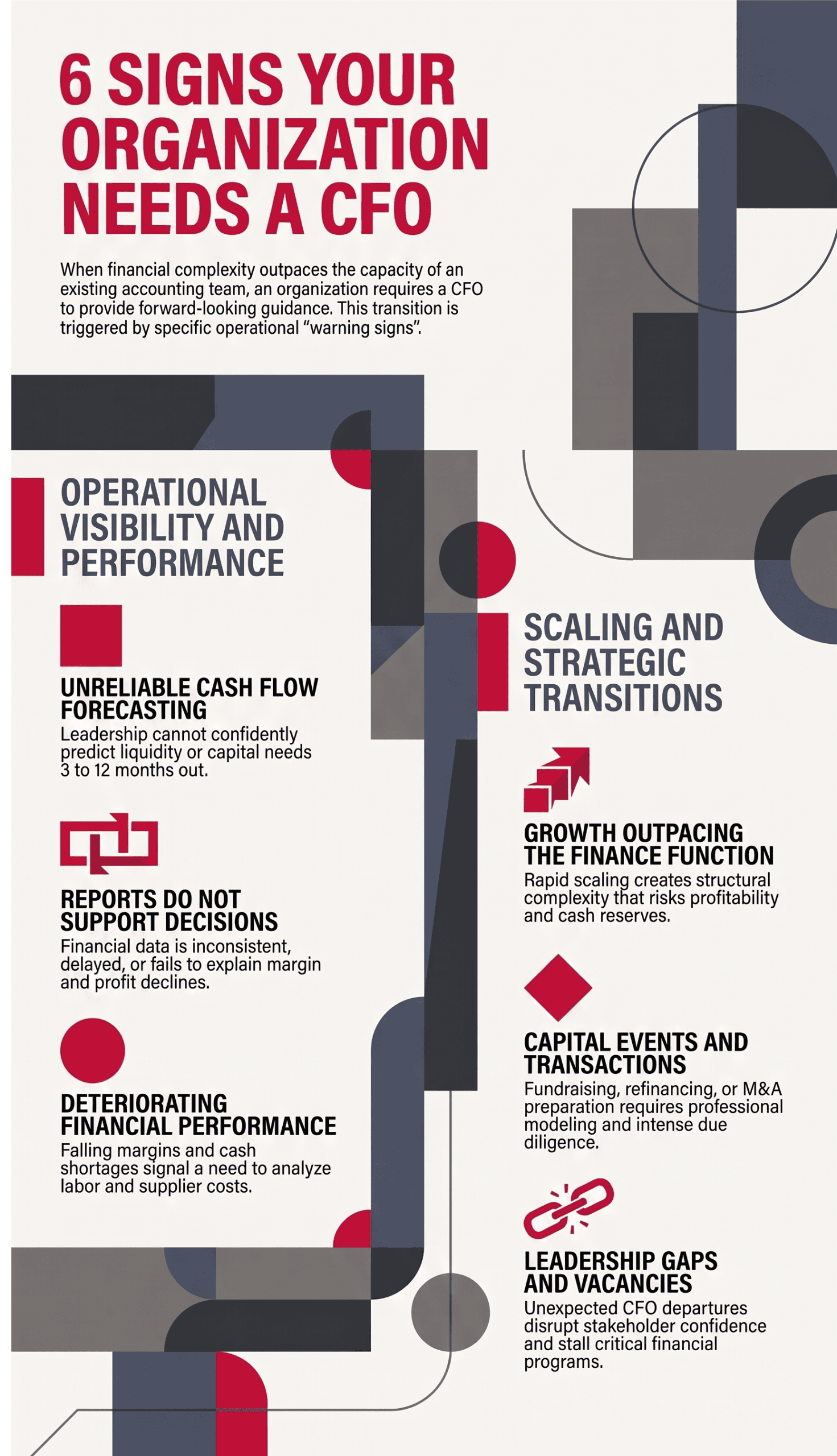
1. You Cannot Reliably Forecast Cash Flow
Historical financial statements tell you what has already happened. A CFO helps you understand what is likely to happen next.
You may need CFO leadership if your team cannot confidently answer questions such as:
- How much cash will we have in three, six, or 12 months?
- Can we afford to hire, expand, or invest in new technology?
- How would a sales decline or unexpected expense affect liquidity?
- When will we need additional capital?
- Can we meet payroll, debt payments, and other obligations?
A CFO builds forward-looking forecasts, tests assumptions, and creates scenarios that help leadership prepare for both opportunities and risks. When cash is tight, an interim CFO can also establish a 13-week cash-flow forecast and identify immediate steps to preserve liquidity.
2. Your Financial Reports Do Not Support Better Decisions
Your accounting team may produce accurate financial statements, but company leaders may still struggle to understand what the numbers mean for the business.
That gap becomes apparent when:
- reporting is inconsistent or delayed;
- departments use conflicting financial data;
- budgets bear little resemblance to actual results;
- leadership cannot identify its most profitable customers or products;
- margins are falling without a clear explanation; or
- major decisions are based more on instinct than financial analysis.
A CFO connects financial performance to operations and strategy. Rather than simply reporting that margins declined, the CFO determines why they declined and what leadership can do about it.

3. You Are Growing Faster Than Your Finance Function
Rapid growth can place as much strain on a business as declining revenue. More customers, employees, products, and locations create additional working-capital requirements and greater financial complexity.
Without experienced financial leadership, a growing company can generate more revenue while becoming less profitable—or even run out of cash.
A CFO helps the company:
- determine whether it can afford its growth plans;
- build scalable reporting and financial controls;
- forecast hiring and capital requirements;
- evaluate pricing and customer profitability;
- align budgets with strategic priorities; and
- ensure that revenue growth converts into cash and profit.
Growth-stage companies do not always need a permanent CFO. A fractional CFO can provide ongoing financial leadership while building the infrastructure the company will eventually need to support a full-time executive.

4. You Are Raising Capital or Refinancing Debt
Investors and lenders expect reliable financial information, defensible forecasts, and a clear explanation of how the company will use its capital.
A CFO can:
- build or validate the financial model;
- prepare investor- and lender-ready reporting;
- evaluate debt and equity alternatives;
- anticipate due-diligence questions;
- assess financing terms and covenants;
- manage relationships with banks, private-credit lenders, and investors; and
- monitor performance after the transaction closes.
Bringing in a CFO before fundraising or refinancing begins is generally more effective than asking one to repair the numbers after investors or lenders have raised concerns.
This becomes especially important when a company is highly leveraged or its lender is tightening credit. Once liquidity is threatened, the company may need an interim CFO or turnaround leader who can move quickly to preserve cash, communicate with lenders, and restore confidence.
Free Guide
The Complete Guide to Interim Management
Free Download
The Complete Guide to Interim Management
Everything owners, investors, and boards need to know about deploying interim executives — when to use them, how to vet them, what to pay, and how to get results fast.
5. You Are Preparing for an Acquisition, Sale, or Exit
Whether your company is buying another business or preparing to be sold, a transaction puts the finance function under intense scrutiny.
A CFO plays a critical role in:
- financial modeling and valuation;
- due diligence;
- evaluating deal terms and structure;
- preparing accurate historical financial information;
- developing credible forecasts;
- identifying financial and operational risks;
- working with attorneys, bankers, and investors; and
- integrating an acquired company after closing.
For a company preparing for sale, clean financials and reliable reporting can reduce buyer uncertainty and protect valuation. An experienced CFO can identify problems before a buyer discovers them and ensure leadership is prepared to explain the company’s performance, risks, and growth potential.y to the next stage.
6. Margins, Cash Flow, or Performance Are Deteriorating
Falling margins, missed forecasts, and cash shortages are often symptoms of deeper operating problems.
A CFO can help determine whether the underlying cause is:
- poor pricing;
- rising labor or supplier costs;
- unprofitable customers or product lines;
- weak working-capital management;
- inaccurate forecasts;
- excessive overhead;
- declining sales productivity; or
- operational inefficiencies.
The CFO then works with the CEO, COO, and other leaders to turn that analysis into measurable action.
Companies should not wait until they miss payroll, violate a debt covenant, or lose lender support. Earlier intervention preserves more options. If the situation is urgent, an interim CFO can take control of cash, reporting, and stakeholder communication while helping leadership develop and execute a recovery plan.
7. Your CFO Leaves or the Finance Team Loses Leadership
An unexpected CFO departure can expose a company to immediate risk. Reporting may slow, lender and investor relationships can suffer, and critical projects may lose momentum.
The problem is especially serious when the company is:
- completing an audit;
- filing public-company reports;
- raising or refinancing capital;
- negotiating an acquisition or sale;
- implementing a new financial system; or
- managing a turnaround.
An interim CFO provides continuity without forcing the company to rush a permanent hire. The interim executive can stabilize the finance function, support the existing team, maintain stakeholder confidence, and help determine what the company needs from its next permanent CFO.
Do You Need a Fractional, Interim, or Full-Time CFO?
Not every company needs—or is ready for—a permanent CFO. The right model depends on the intensity, duration, and urgency of the need.
Fractional CFO
A fractional CFO provides ongoing financial leadership on a part-time schedule. This model works well when a company needs stronger forecasting, cash management, board reporting, or strategic finance support but does not require CFO-level involvement every day.
A fractional CFO may work a few hours each week or several days per month, depending on the company’s needs. As the business grows, the engagement can expand or help prepare the company to hire a permanent CFO.
Learn More: How to Hire a RED Team fractional CFO
Interim CFO
An interim CFO provides concentrated leadership for a defined period. Interim CFOs are often brought in when:
- the previous CFO leaves unexpectedly;
- the company faces a cash or performance crisis;
- a transaction or refinancing is underway;
- the finance team needs restructuring;
- financial reporting or controls have broken down; or
- a major transformation must be completed quickly.
An interim CFO can assume full executive authority, lead the finance team, and remain through the search and onboarding of a permanent replacement.
Learn More: How to Hire a RED Team Interim CFO
Full-Time CFO
A permanent CFO makes sense when the company’s financial complexity is structural rather than temporary and CFO-level leadership is required every day.
Common indicators include:
- multiple entities or international operations;
- regular lender, board, or investor demands;
- sophisticated capital-allocation decisions;
- ongoing acquisitions;
- complex regulatory requirements; and
- a large finance organization requiring permanent leadership.
For a detailed comparison, read Fractional CFO vs. Interim CFO vs. Full-Time CFO: Which Do You Need?
What a Great CFO Brings to the Business
Whether fractional, interim, or permanent, a strong CFO does more than “keep the books.” The CFO improves financial visibility and helps the entire leadership team make better decisions.
Key contributions include:
- cash-flow management and forecasting;
- budgeting and scenario planning;
- financial modeling;
- KPI development and performance tracking;
- debt and equity financing;
- lender and investor communication;
- stronger controls and audit readiness;
- margin and profitability improvement;
- M&A, exit, and restructuring support; and
- development of the internal finance team.
The best CFOs combine financial discipline with a deep understanding of the company’s operations, customers, and competitive environment.
Don’t Wait Until the Need Becomes a Crisis
Many companies wait too long to bring in a CFO because they assume senior financial leadership is only for large corporations. But the need for a CFO is determined by complexity and risk—not simply revenue or headcount.
By the time cash is critically low, reporting has broken down, or a lender has lost confidence, the available options are narrower and more expensive.
InterimExecs matches companies with vetted RED Team interim and fractional CFOs within 48 hours. Whether the need is ongoing strategic support or immediate hands-on leadership, the right CFO can restore financial visibility, strengthen decision-making, and prepare the business for what comes next.
Need help now?
Talk to Us About Your Organization’s Needs
RED Team CFOs are rock star financial leaders who know how to guide organizations through acquisition, turnaround, growth, exit, IPO, and daily financial challenges.
Read More
Frequently Asked Questions
You likely need a CFO when your business is experiencing rapid growth, raising capital, facing cash flow complexity, or preparing for an audit or exit. It goes beyond managing the numbers at that point, and strategic CFO support can be a game-changer. If you’re unsure whether your organization is ready for a full-time CFO, start with a part-time or fractional CFO.
Startups and growth-stage companies typically hire a CFO when they begin raising capital, managing investor relations, or need financial forecasting to scale. A fractional CFO brings deep experience to the table, helping early-stage companies build investor confidence, streamline fundraising negotiations, and avoid costly financial missteps.
Yes. Many companies hire a part-time CFO, known as a fractional CFO, to get high-level financial leadership without the cost of a full-time executive. Fractional CFOs are ideal for startups, lean teams, or businesses that need strategic financial guidance but aren’t yet ready for a permanent CFO.
A fractional CFO provides long-term, part-time financial support to growing companies. An interim CFO typically works full-time for a short, defined period—stepping in during a leadership gap, financial crisis, or major transition.