847.849.2800
 Contact

3 Key Takeaways
Why the Private Credit Crisis Is an Operational Challenge
- Private credit has entered a credit cycle.
Defaults, non-accrual loans and lender takeovers are increasing across private-credit portfolios.
- The weakest loans often date from the 2020–2021 lending boom.
Companies financed when interest rates were low and valuations were high are now struggling to service debt while continuing to invest in growth.
- Financial stress quickly becomes an operational problem.
Interim CEOs, CFOs and chief restructuring officers can stabilize cash flow, improve lender reporting and lead the operational changes needed to preserve value.
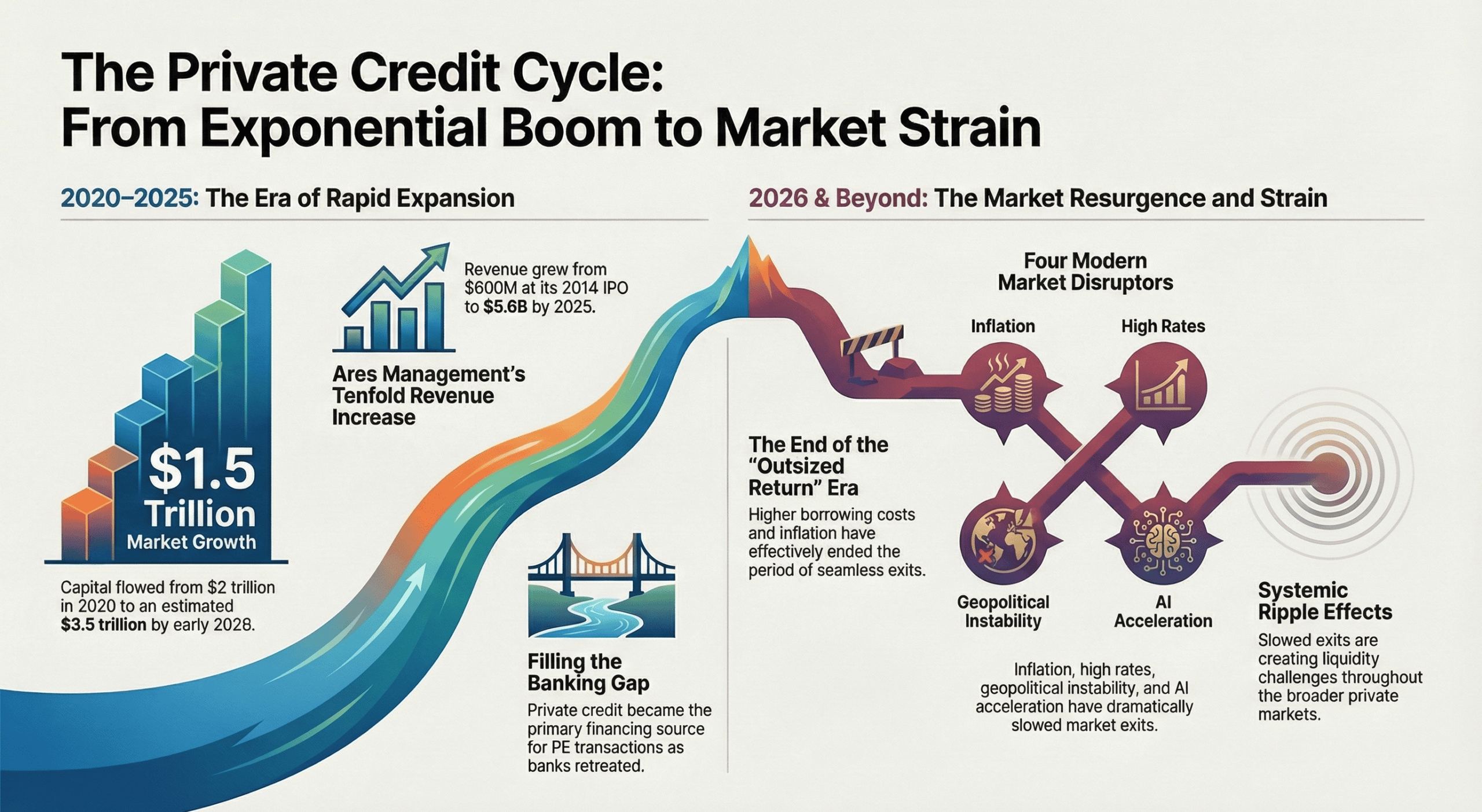
For years, low interest rates and abundant private credit helped PE firms finance acquisitions and fuel portfolio company growth. Many deals made in 2020 and 2021 assumed that inexpensive refinancing, rising valuations and attractive exits would continue.
That environment has changed. Higher interest costs are consuming cash that otherwise would fund hiring, product development and expansion. The result is a dangerous cycle: debt service limits investment, weaker investment slows growth, and slower growth makes refinancing or selling at an acceptable valuation even harder.
Some PE firms are now holding companies longer, injecting additional capital, even selling assets at a loss to maintain liquidity.
What began as a credit and refinancing challenge has become an operational leadership crisis, driving demand for interim executives, fractional CFOs and turnaround leaders who can stabilize cash flow and performance.
The End of Easy Money in Private Equity
Private credit expanded rapidly during the era of historically low interest rates. Direct lenders and alternative credit providers offered flexible financing solutions that helped fuel leveraged buyouts and portfolio company growth strategies.
For PE-backed companies, success depended on several assumptions:
- refinancing would remain accessible,
- debt costs would stay manageable,
- valuations would continue climbing,
- and exits would remain available through IPOs or strategic sales.
Those assumptions no longer hold.
Today, PE-owned portfolio companies face:
- significantly higher debt servicing costs,
- constrained access to refinancing,
- slower growth,
- declining valuations,
- and growing pressure from lenders and investors.
At the same time, PE firms are struggling to sell portfolio companies at valuations that support targeted returns.
The result is a growing liquidity challenge throughout private equity markets.

Private Credit Stress Is Showing Up in the Numbers
The newest data suggests private credit has moved beyond scattered problem loans and entered a broader credit cycle.
An August 2026 Financial Times analysis found that troubled loans held by some of the industry’s largest investors had climbed to levels last seen in 2017, when private-credit portfolios were still absorbing losses caused by the oil-price collapse.
Among the 20 largest publicly traded business development companies, or BDCs, loans on non-accrual status reached a median 2.8 percent of cost during the second quarter. That was up from 2 percent at the end of March. A loan is generally placed on non-accrual status when a borrower has stopped making interest payments or the lender believes full payment is unlikely.
The FT also reported several other warning signs:
- Private-credit defaults reached a record in July, according to Fitch Ratings.
- The largest publicly traded BDCs contracted again during the second quarter as repayments, loan sales and impairments exceeded new investments.
- Some lenders are marking troubled loans substantially below face value.
- Private-credit managers are becoming more defensive and conserving capital in anticipation of additional volatility.
- Several major BDCs have seen their share prices fall sharply as investors question portfolio valuations and future losses.
David Golub, co-CEO of Golub Capital, characterized the situation plainly during an investor call: “We’re in a credit cycle.”
The pressure is not uniform. Some private-credit managers maintain that the problems remain concentrated in a relatively small number of loans and that most borrowers continue to produce adequate cash flow. But the trend is clear: problem loans, restructurings and lender takeovers are becoming more common.
The Financial Times editorial board subsequently warned that regulators and investors should pay closer attention to the strain emerging in direct lending.
Stay Ahead
Leadership Insights for Owners, Investors & Boards
Join executives, PE sponsors, and board members who receive ideas every month from InterimExecs on transformational leadership and business growth.
What Troubled Private-Credit Loans Mean for Portfolio Companies
A loan does not have to default before it begins limiting a company’s options. As earnings weaken or debt covenants tighten, lenders may demand more frequent reporting, stricter cash controls, asset sales, additional sponsor equity, or significant operational changes.
When that happens, portfolio-company leaders need to:
- prepare reliable 13-week cash-flow forecasts;
- improve working-capital management;
- renegotiate loan terms or covenant requirements;
- provide lenders with more frequent and credible financial reporting;
- prioritize profitable customers and products;
- suspend lower-priority investments;
- sell noncore assets;
- reduce costs without damaging the company’s ability to recover;
- develop restructuring and contingency plans; and
- rebuild confidence among employees, customers, suppliers and lenders.
These are not simply finance-department assignments. They require coordinated leadership across the entire organization.
A vetted, experienced interim CFO can establish control over liquidity, forecasting and lender communications. A qualified interim CEO with a record of successful turnarounds or a veteran interim COO who has been there and seen that can convert that financial plan into operational action. In more serious situations, a chief restructuring officer can lead negotiations and execute a formal or out-of-court restructuring.
Why Interim Executives Are Today’s Strategic Imperative
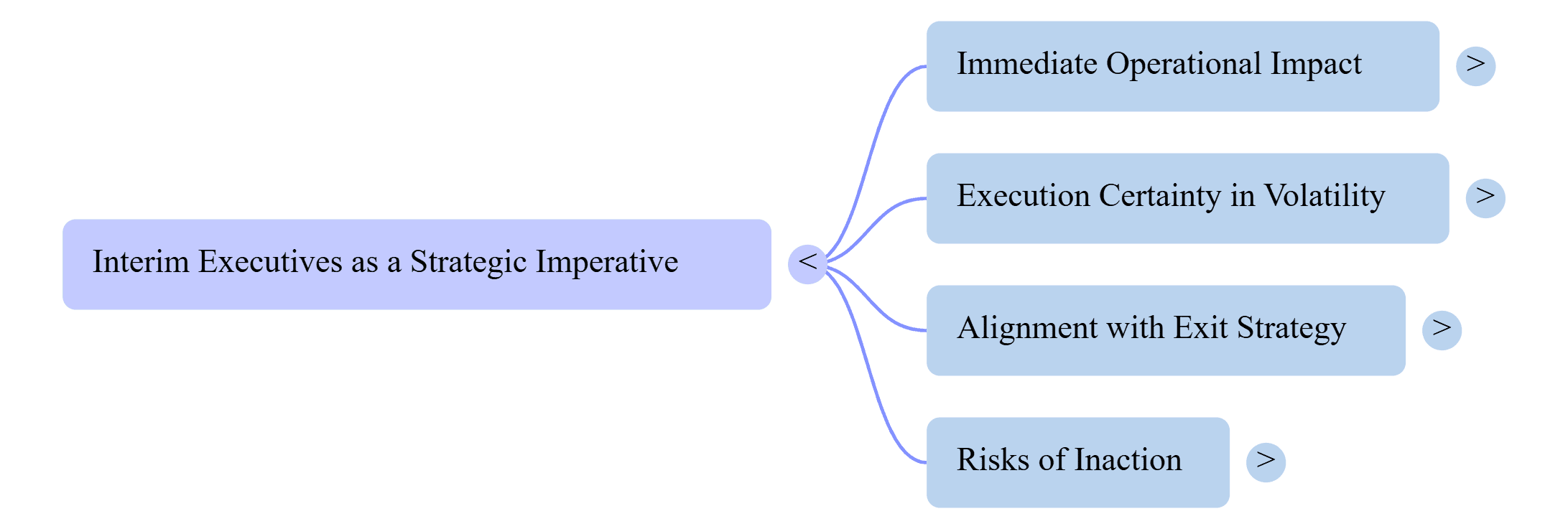
In this environment, experienced interim leaders aren’t a luxury; they are mission-critical.
Here’s why:
They Deliver Immediate, Hands-On Operational Impact
Family offices and PE funds have never had the mindset of later-is-better, or allowing management a long ramp-up time to improve. Interim executives step in fast and begin driving performance improvements that are exit-relevant, even when markets aren’t cooperating.
When the sources of funding and cash necessary for operations and growth is not available – namely, more borrowing – it’s time to get scrappy and creative with objective outside leadership expertise brought to bear immediately. Because none of us can control markets, but we can control our actions and behavior to be ready.
They Turn Volatility Into Execution Certainty
Whether the challenge is margin pressure, refinancing stress, or pivoting product strategy, interim leaders bring battle-tested experience across industries. They know what works under strain and they are wired for change.
They Align Portfolio Operations With Exits
Smooth operations, clean earnings, and clear growth pathways materially improve buyer confidence. In tight markets, that’s worth multiple points of valuation.
Case in point: we were called into a PE fund’s poorly performing portfolio company with the instructions to our InterimExecs RED Team CEO to “break no glass.” In other words: don’t make big waves.
The end result? Disastrous.
The fund knew things were bad but feared the unknown. The reality turned out far worse.
The current market is flashing alarms that the time is now.
The Rising Demand for Fractional and Turnaround Leadership
Private equity firms are increasingly relying on:
- interim CEOs,
- fractional CFOs,
- chief restructuring officers (CROs),
- turnaround specialists,
- operational transformation leaders,
- and interim HR executives.
These executives bring specialized expertise in:
- distressed operations,
- organizational restructuring,
- accelerated performance improvement,
- lender negotiations,
- liquidity management,
- and crisis leadership.
Unlike traditional executive searches, interim leadership solutions allow PE firms to deploy experienced talent quickly while maintaining flexibility during uncertain market conditions.
That flexibility has become particularly important as portfolio companies face rapidly changing financial and operational realities.
Free Guide
The Complete Guide to Interim Management
Free Download
The Complete Guide to Interim Management
Everything owners, investors, and boards need to know about deploying interim executives — when to use them, how to vet them, what to pay, and how to get results fast.
The First 90 Days Matter
Once a lender begins questioning performance, speed matters. The first 90 days should focus on establishing facts, preserving liquidity, and restoring credibility, all the hallmarks of strong interim leadership.
An experienced interim leadership team will:
- Establish a reliable cash position. Build a 13-week cash-flow forecast and identify immediate liquidity risks.
- Validate operating performance. Determine which customers, products, locations and business units generate or consume cash.
- Improve lender communication. Provide timely information, realistic forecasts and a specific corrective-action plan.
- Set measurable priorities. Assign owners, deadlines and financial targets to each recovery initiative.
- Prepare alternatives. Develop plans for refinancing, additional sponsor capital, asset sales, restructuring or a distressed transaction.
The Private Credit Crisis Is Reshaping PE Leadership Strategy
The private equity industry evolves in response to changing market conditions.
Today’s environment is creating a new emphasis on operational resilience, leadership execution, and cash flow discipline.
Investors, lenders, and boards are increasingly focused not only on financial performance, but also on whether leadership teams can operate effectively under sustained pressure.
As a result, interim and fractional executives are becoming strategic assets rather than temporary placeholders.
For many PE firms, experienced operational leadership is now central to portfolio company stabilization, refinancing readiness, and long-term value preservation.
Need help now?
Talk to Us About Your Portfolio
RED Team executives onsite in as little as 48 hours — assessing the need, building the plan, leading the change.
Read More
Frequently Asked Questions
A business development company, or BDC, is an investment company that provides loans and sometimes equity financing to small and midsize businesses. BDCs often lend to PE-backed companies that need greater speed, flexibility or leverage than a commercial bank will provide.
BDCs typically lend to companies with more leverage, weaker credit profiles or more complex financing needs. Because these loans carry greater risk, BDCs charge higher interest rates and fees. Borrowers are paying for faster decisions, flexible loan structures and access to capital they may not qualify for through a traditional bank.
The company may quickly face a liquidity crisis that threatens payroll, vendor payments and daily operations. Leadership must immediately assess cash, build a reliable 13-week cash-flow forecast and begin discussions with lenders and investors. An interim CFO, CEO or turnaround executive can take control quickly, identify financing alternatives, stabilize operations and rebuild lender confidence.
PE firms increasingly need experienced leaders who can stabilize operations quickly, improve cash flow and guide portfolio companies through restructuring or operational transformation. Within 48 hours you can match with a top-tier vetted interim executives like those in InterimExecs’ RED Team, who can immediately jump in to take stock and make changes that put companies on a path to success.
Common roles include interim CEOs, fractional CFOs, chief restructuring officers (CROs), turnaround specialists and operational transformation leaders.
InterimExecs RED Team is the pioneer in the interim and fractional marketplace in the United States. That longevity has allowed us to rigorously rank, score, and screen 9,000+ interim and fractional executives so your private equity fund, family office, or shareholders don’t have to wade through mediocre or average candidates.
We have built trusted relationships so that we can make quality recommendations at speed. We are solely focused on interim and fractional search meaning we only work with change agents and executives who have proven excellence time after time.
Need help now?
Talk to Us About Your Portfolio
Reach out for a confidential conversation about how our vetted RED Team interim and fractional executives can drive the change your portfolio companies need. Our battle-tested CEO, CFO, and COO leaders can instantly deploy to assess the need, create the plan, and lead the change.