How To Do a Reverse Merger Into a Public Shell Company in 9 Not So Easy Steps. Or SPAC in 10!

A reverse merger into a public shell company or completing a SPAC merger can provide a path for companies going public without an IPO. While these strategies can happen faster than a traditional IPO, they are complex transactions involving regulatory compliance, financial restructuring, governance changes, and investor scrutiny. That means they need seasoned C-suite leadership to execute properly.

The Market Context: Why Reverse Mergers and SPAC Deals Are Returning

During the market surge of 2021, SPAC mergers became one of the most talked-about alternatives to the traditional IPO. In a zero-interest-rate environment, special purpose acquisition companies (SPACs) brought many private companies to public markets with fewer barriers than the standard IPO process.

When market conditions tightened and stocks declined, SPAC activity slowed significantly. However, the SPAC market has begun to rebound.


What 2025 Meant for Interim Leaders — and Why 2026 Is the Inflection Point

2025 was significant for our tribe of leaders serving as expert interim and fractional executives. What happened? Here are the highlights, followed by what we see coming:

1. Interim and Fractional Leadership Went Mainstream

Back in 2007 we launched the predecessor to InterimExecs. NO ONE had a clue what we were talking about. Interim? What’s that? Are they in between jobs? Retired? Consultants?

No more. Business finally gets executives-on-demand. Specialized expertise for what you need right now? That’s a huge plus – it resonates.  And a minus – you’re no longer alone in the field. There’s a lot more noise.

Read More

Guide to Hiring a Fractional CFO: What to Know Before You Make the Call

Hiring a fractional CFO could be one of the most impactful decisions you make this year. Whether your company is preparing for growth, managing a complex financial challenge, or gearing up for fundraising, a seasoned financial leader can bring clarity and direction — without the overhead of a full-time hire.

In this guide, we break down when to bring in a fractional CFO, what to expect, how to choose the right one, and how InterimExecs can match you with a RED Team leader who’s ready to make an immediate impact.

Read More

Recession Proofing Your Business: 7 Steps to Take Right Now

Stock market volatility. Rising unemployment rates. Still-high interest rates. Will those tricky statistics lead to an economic downturn? The jury is still out. But it makes sense to do what you can right now to recession-proof your business.

Whether you’re an entrepreneur, a small business owner, or a business leader overseeing a Fortune 500 mega-corporation, there are steps you can — and should — take right now to increase the chances your company will survive economic uncertainty.

Read More

Interim Executive Trends We See Right Now

As the Greek philosopher Heraclitus is famously quoted as saying: “Change is the only constant in life.” And this year will bring a torrent of change!

As we have deployed InterimExecs RED Team members and talked with interim executives, company owners, and private equity investors, we have seen five common themes emerge:

Read More

2023 Predictions: Business Trends Accelerating Need for Interim Executives

Every new year means new challenges and new opportunities. This new year, 2023 is no different! When we asked 204 C-level executives for their 2023 predictions, their responses reflected five clear business trends:

  • A surge in executive retirements and leadership departures
  • Ongoing workplace changes
  • Continued supply chain challenges
  • Technology needs
  • The looming threat of an economic downturn

Let’s take those one at a time.

Read More

CEO Turnover: Why the Bosses Are Leaving & Who’s Replacing Them

Millennials and Gen Z employees might get all the press for their “Great Resignation” but they aren’t the only ones who are leaving their jobs in droves. CEOs are too. The Great CEO Turnover, which peaked in 2021 and early 2022, has leveled off a bit. But it certainly doesn’t mean that your CEO is planning to stick around for the long haul.

Outplacement firm Challenger, Gray & Christmas compiles a monthly report on the CEO turnover rate. The July 2022 report shows that CEO changes at U.S. companies fell to 58 in July, down 45% from the 106 CEO exits recorded in June. It was the lowest monthly total since the early pandemic departures of April 2020.

However, departing CEOs are hardly a thing of the past.

When Deloitte and independent research firm Workplace Intelligence surveyed 2,100 employees and C-level executives in the United States, United Kingdom, Canada, and Australia, they found that an eye-popping 70% of top management are seriously considering quitting for a job that better supports their well-being. And 81% of the top execs say that improving their well-being is more important than advancing their career.

Read More

Venture Capital 101: How to Survive and Thrive When VC Funds Dry Up

Way back in 2009, the Great Recession hit America. And it didn’t pass me by.

In case you don’t remember how bad things were, let me refresh your memory: Bear Stearns failed. Lehman Brothers failed. Merrill Lynch sold for next to nothing. Countrywide Mortgage sold for pennies on the dollar. AIG had to be propped up by the federal government. General Motors went bust, was put on life support thanks to the federal government. People were worried. They wondered whether they would go to the ATM one day and no cash would come out because their bank had failed.

And me? I was at a startup called PV Powered. We were developing the next generation of commercial and utility grade solar inverters. We had about 100 angel investors and we were burning $750,000 a month when the Great Recession hit despite as much bootstrapping as possible. The next thing we knew, 98 percent of the investors had backed out, equity stake be damned, announcing they would no longer support the company. And who could blame them?

Read More

5 Trends Expanding the Need for Interim Executives Now

Even before the pandemic forced businesses to be more nimble and forward-thinking than ever before, the need for interim executives had been growing. In 2020, we asked 600+ execs to shed light on interim roles, a comprehensive survey that covered the who, what and why behind the growth of this category. And now as the world is finally defeating COVID-19, businesses are continuing to adapt and re-strategize with a new set of challenges, only amplifying the need for experienced, “make it happen” interim executives even more. 

To better understand how the current marketplace is dictating the need, we conducted a follow-up survey, asking 125 executives to answer the same question: What trends do you anticipate having the greatest effect on the interim specialty in the year ahead?” 

Interim Management Trending Up

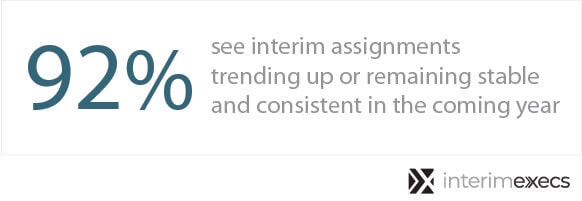
Across both surveys, the conclusion was clear: interim executives are needed now more than ever. 71% of respondents see opportunities for interim management trending up and another 21% seeing they will remain stable throughout the coming yearHere, we break down the five reasons why more organizations are drawing on interim executive leadership:

Read More

5 Highlights from InterimExecs in 2020

Every day at InterimExecs we are reminded of how grateful we are to work with inspiring leaders, owners, investors, and boards. While 2020 was a year of huge challenges, we saw many companies take time to reflect on how they could do better, embrace change, and seize new opportunities.

It was a full year and we are excited to share the InterimExecs RED Team 2020 Year in Review.

We are eager to continue helping other amazing companies secure expert RED Team leadership for their biggest challenges and greatest opportunities. Let us know how we can be a resource as you charge forward into 2021.