847.849.2800
 Contact


When technology initiatives stall, the culprit is rarely the software itself. It is a misalignment between business objectives, internal inertia, and fragmented IT execution. Here, three veteran interim CIOs share their insights into the fast-evolving tech challenges.
Technology is evolving at a breakneck pace; unprepared mid-market enterprises and private equity portfolio companies will fall behind. Systems are disconnected, legacy architectures buckle under modern demands, and leadership teams are paralyzed by AI vendor hype.
To understand how high-performing companies navigate complex tech turnarounds, we spoke with veteran interim CIOs from the InterimExecs RED Team: David Mitchelhill, Kevin Malover, and Jamie Marra.
With decades of experience executing ERP replacements, modernizing software delivery, and navigating the pragmatic realities of artificial intelligence, they share their insights into what it takes to transform an organization through technology.
1. Aligning IT with Business Strategy (Not the Other Way Around)
A recurring trap for organizations embarking on digital transformation is starting with the technology rather than the business objective. Companies purchase enterprise-grade tools, embark on complex cloud migrations, or adopt AI integrations without articulating the commercial outcome they expect to achieve.
Interim CIO Kevin Malover points out that leadership teams frequently frame the problem backwards:
People ask, ‘What’s your IT strategy?’ Well, that’s the wrong question really. The question should be, ‘What’s your business strategy and how’s IT going to enable that?’
— Interim CIO Kevin Malover
When technology operates disconnected from business strategy, capital expenditures balloon while strategic agility plummets. Bridging this divide requires leaders who can speak the language of the boardroom, finance, and software engineering with equal fluency.
2. Breaking Through Legacy System Inertia
The most formidable barrier to enterprise modernization isn’t always technical complexity. Sometimes, it’s emotional and organizational attachment to legacy systems.
David Mitchelhill, a seasoned interim CIO who has led turnaround engagements across multiple continents, notes that legacy platforms often become comfortable crutches that mask deep inefficiencies.
I’ve had discussions with companies over many, many years, where they say, ‘We spent a fortune on our legacy system over the last 20 years. We’re really used to it and we like it.’ The realization that the world has changed is quite often a very difficult thing for companies to accept.
— Interim CIO David Mitchelhill
Without executive sponsorship and an external leader who can clearly articulate the business cost of technical debt, companies fall victim to the sunk-cost fallacy. Investments remain focused on keeping antiquated systems on life support rather than enabling competitive innovation.
3. Cutting Through the AI Hype: Practical Utility Over Empty Demos
Boards and private equity sponsors are pushing leadership teams to develop an “AI strategy.” The response is a rush into high-priced pilot programs without clear governance, validation, or demonstrable ROI.
Interim CIO Jamie Marra, who specializes in high-velocity software engineering, cloud architecture, and applied AI, cautions against adopting technology simply because enterprise software vendors are pushing it. He says the true promise of AI in an enterprise setting hinges on data reliability, token economics, and rigorous verification, not flashy presentations:
Private equity would love to use AI more if they could believe what the outputs are saying in a consistent way. And so I thought that was an interesting challenge to use AI, but be able to identify when and if it was hallucinating, lying, being lazy.
—Interim CIO Jamie Marra
Marra emphasizes that while machine learning models can drastically accelerate software pipelines and reduce labor overhead, they cannot replace experienced strategic leadership. However, when approached with a builder’s discipline, the productivity upside can be massive.
By reimagining enterprise CI/CD workflows through pragmatic AI tooling, Marra says, “I took everything that I’ve been used to doing in enterprise, overlaying it onto the AI and coming out with, well, holy shit, I don’t need a team of 50 now.”
The Complete Guide to Interim Management
Everything owners, investors, and boards need to know about deploying interim executives — when to use them, how to vet them, what to pay, and how to get results fast.
4. The Outsider’s Advantage: Radical Truth and Zero Corporate Politics
Why bring in an interim CIO rather than relying solely on internal managers or traditional management consulting firms? Because neither is as effective or efficient as bringing a vetted, experienced interim leader onto the executive team.
Unlike permanent executives, interim leaders are not constrained by internal politics, silo protection, or the fear of delivering uncomfortable truths to the CEO and board. And, unlike external management consultants, interim CIOs are expected to deliver tangible results, not just diagnostic reports and recommendations.
I can say things others can’t. And I’m not worried about protecting turf or climbing the corporate ladder. I’m there to solve the problem.
— Interim CIO Kevin Malover
5. The Interim CIO Execution Framework
Digital transformation is not a software purchase; it is an organizational restructuring enabled by modern tools. Interim CIOs focus on holistic execution across people, process, governance, and architecture.
When I come in, I’m not just assessing the tech stack. I’m looking at the people, the org chart, the decision-making process, vendor contracts, how information flows. Because that’s where transformation really begins.
— Interim CIO David Mitchellhill
How Interim CIOs Work
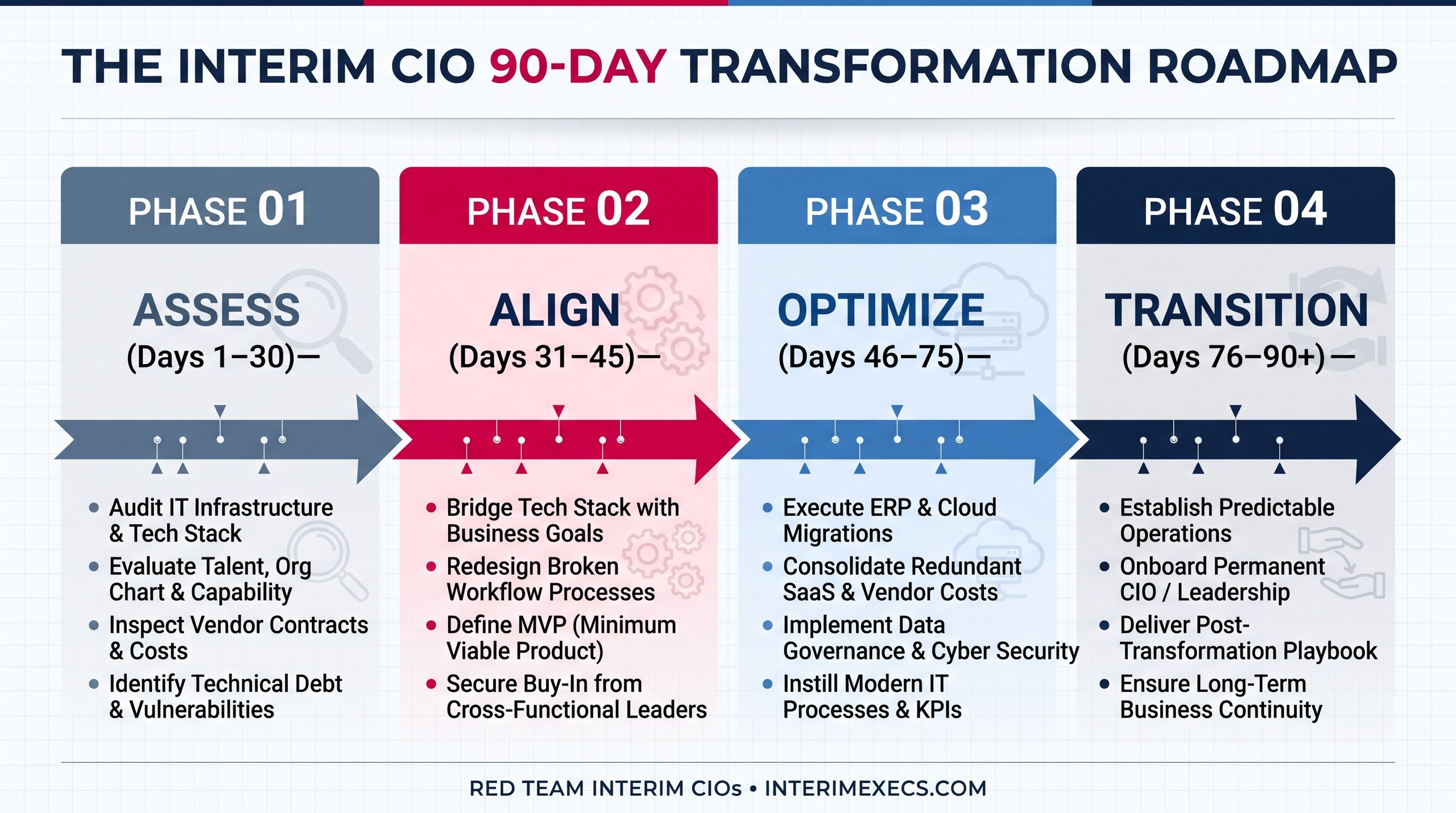
Phase 1: Rapid Diagnostic (Days 1–30)
- Conduct an unsparing audit of IT infrastructure, custom codebase, technical debt and AI structure.
- Review software licensing, cloud consumption, and third-party vendor contracts for immediate cost recovery.
- Assess internal engineering talent, organizational bottlenecks, and team morale.
Phase 2: Strategic Realignment (Days 31–45)
- Align technical milestones directly with core business revenue and EBITDA drivers.
- Strip away legacy processes that add friction instead of value.
- Establish clear data hygiene and validation standards before rolling out automated or AI-assisted tooling.
Phase 3: Focused Optimization (Days 46–75)
- Eliminate redundant SaaS subscriptions and renegotiate bloated vendor agreements.
- Direct stalled ERP or cloud migrations toward a defined Minimum Viable Product (MVP).
- Fortify cybersecurity posture, disaster recovery protocols, and governance guardrails.
Phase 4: Predictable Transition (Days 76–90+)
- Institutionalize transparent IT performance metrics (KPIs) and operating cadences.
- Write the organizational playbook for continuous improvement.
- Assist board leadership in recruiting, vetting, and onboarding the permanent CIO or technology leader.
Frequently Asked Questions
A technology consultant typically provides high-level assessments, audits, and strategic recommendations in a report or presentation, leaving implementation to the client. An interim CIO is a part of the executive team responsible for delivering high-impact results.
Experienced interim CIOs prioritize practical utility, data security, and verifiable ROI over vendor hype. They focus on establishing reliable data architecture, auditing token and tooling costs, and implementing automated verification checks to ensure AI outputs are accurate, compliant, and directly tied to operational productivity.
Because interim CIOs have no long-term ties to external software vendors or internal corporate loyalties, they conduct objective audits of total cost of ownership (TCO). They benchmark existing contracts against current market rates, identify unused or duplicative SaaS seats (“shelfware”), and consolidate fragmented vendor stacks. When renegotiating with major vendors, their hands-on cross-industry enterprise experience allows them to eliminate unnecessary licensing tiers and strip out costly maintenance commitments without disrupting daily operations.
Typically within 48 hours for initial conversations, with executives onsite within days. In urgent situations — fraud discovery, sudden leadership departure, deal closing — we’ve placed executives in as little as 24 hours from first call.
Most assignments for InterimExecs RED Team leaders run 6–18 months.
Talk to Us About Your Dream Team
Tell us what you’re trying to accomplish, and we’ll match you with the right executive from the InterimExecs RED Team.
Matches in as Little as 48 Hours