847.849.2800
 Contact

Master Class With Paul Fioravanti
Key Takeaways: 7 Principles of a Successful Business Turnaround
- Stabilize Leadership
Make leadership changes early to reset direction and build confidence.
- Plan, Organize, Motivate, Control (POMC)
Share the battle plan so every employee understands their role in the turnaround.
- Transform Company Culture
Create accountability and an entrepreneurial mindset throughout the organization.
- Communicate Early & Often
Meet directly with employees, customers, and vendors to build trust during change.
- Protect Cash Flow
Eliminate non-critical spending and improve liquidity to stabilize the business.
- Focus on Sustainability
Build a business model designed for long-term success, not just short-term recovery.
- Engage Employees
Involve employees because they often have the best ideas for improving operations.
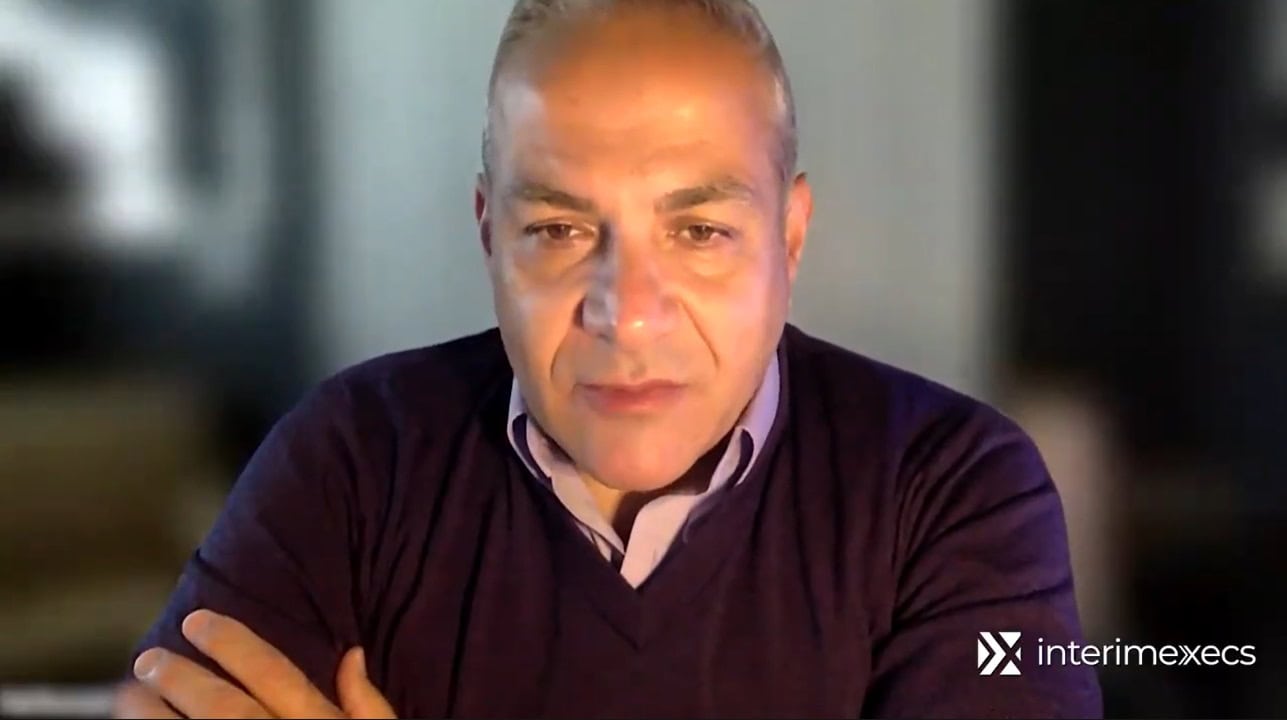
Paul Fioravanti is a veteran interim executive. He is a turnaround expert who has been in some 90 engagements across 40 industries — as a CEO, COO, CTO (Chief Transformation Officer), CRO (Chief Restructuring Officer), General Manager or President.
So he knows a thing or two about how to get things done.
In our most recent Master Class video, InterimExecs CEO Robert Jordan talks with Fioravanti about his turnaround process and, in particular, his experience turning around Avara Pharmaceuticals.
Avara is a private equity-backed Big Pharma rollup that faced an imminent cash crisis and looming insolvency before Fioravanti came in as interim Chief Executive Officer. Thirteen months later, the company was $32 million positive and had achieved financial stability.
Here’s how he did it.
The Turnaround Management Challenge
Avara had eight plants filled with employees of legacy pharmaceutical companies such as Pfizer and Merck. Fioravanti’s challenge: “Taking legacy corporate cost-centered employees and asking them to be entrepreneurial sales-driven and efficiency-driven employees.”
Four of the eight plants were underperforming; working at about 30 percent capacity utilization. Fioravanti was charged with driving contract manufacturing to the plants, fully utilizing the production capacity, and returning the plants to profitability.
And he had to do that while navigating complex regulatory authorities, rigid asset purchase agreements, unbreakable employment contracts, and unrealistic forecasts for commercial opportunities.
One of his biggest challenges: a legacy pharma company is focused on research and development. One plant in Canada had 60+ research scientists on the payroll. But the new company wasn’t doing R&D. It was contracting manufacturing business.
The business owners and management team needed salespeople, not researchers.
POMC Business Turnaround Methodology
POMC — Plan, Organize, Motivate, Control — is an employee-driven approach.
“I describe it as sharing the battle plan,” Fioravanti told Jordan.
Much like a football team practices running plays to ensure everyone understands their role, Fioravanti is the Tom Brady of this scenario. It’s his job to get everyone from the management team to the line workers to buy in, understand the fundamentals, and move in the right direction.
“The M is the critical piece. It’s the motivation. And the C is just making sure everybody is doing what they’re supposed to do so the deliverables are being met and the KPIs are being hit.”
Focus on Company Culture
“Culture is what wins the war. Managers going through a period of change really have to be high EQ. It’s much more important than high IQ,” he says, referring to emotional intelligence over intellectual ability.
Culture is what wins the war. Managers going through a period of change really have to be high EQ. It’s much more important than high IQ
— Paul Fioravanti, InterimExecs RED Team
His long-time business partner and mentor, Jim Malone, liked to say: Culture is determined by the worst behavior an organization tolerates.
In Big Pharma, that can mean a rigid culture in which plants are overstaffed. It’s a “little bit of a journey” to get from there to an entrepreneurial mindset, Fioravanti says.
“How do you turn a 20- or 25-year employee of some huge global company into an overnight entrepreneur?”
Communication
The first thing Fioravanti did was fire the CEO, CFO, and COO and reduce the headquarters staff. It sent a shock wave through the company. So the next step in this turnaround plan: Visit every company location to meet with all of the stakeholders — employees, customers, and vendors.
“You have to get in front of them,” he says.
The message: Yes, it’s a change, but it’s not a negative change. We’re not going out of business. We’re making management changes to refocus the business, increase sales, and return to viability.
“The word I kept using was ‘sustainability.’ If you do not have a sustainable business model, you won’t be in business. Your customers and the customers’ customers are relying on you to be a sustainable provider.”
If you do not have a sustainable business model, you won’t be in business. Your customers and the customers’ customers are relying on you to be a sustainable provider.
— Paul Fioravanti, InterimExecs RED Team
Cease All Non-Critical Spending
Bulking up liquidity and getting costs in line was the next critical step in his business turnaround strategy. It meant looking at everything from energy costs at each manufacturing site to renegotiating seller notes and freezing past-due payables. He went so far as to negotiate to give back a couple of the poor-performance sites, ultimately reducing the company from eight sites to four.
When a plant is losing money and the healthy sites are subsidizing it, “it doesn’t make sense for us to own it,” he says. “We need to unring that bell, if possible.”
His cost-saving efforts were wide-ranging and challenging. He had to deal with energy costs in Puerto Rico, non-layoff worker protections in Europe, and legacy manufacturing processes that required 35 people on the line when only 7 were needed after the process was redesigned.
Key Learnings
The biggest lesson learned from his change management experience: People are the key. Every time he goes into a turnaround situation, Fioravanti focuses on involving the employees “because they have the solutions.”
“I sit the employees down. We have a town hall meeting. I say, ‘You guys have forgotten more about this industry than I’ll ever know. But I can’t do my job unless you help me through this process.'”
Other lessons he has learned from many, many successful business turnarounds:
- The importance of a strong leadership team
- The need for clear communication and trust-building
- The need to focus on sustainability
In Need of a Turnaround?
Request a Confidential Call
Most businesses lack the expertise needed to return a troubled organization to profitability. That’s when a short-term interim executive with proven business turnaround experience is the answer. Reach out to us to learn how a RED Team interim executive can rescue your business.
Read More
Frequently Asked Questions
A business turnaround is a focused effort to stabilize and improve a company experiencing financial, operational, or strategic decline. It typically combines immediate cash-flow management with leadership changes, cost reductions, operational improvements, stakeholder communication, and a longer-term plan to restore profitability and create a sustainable business model.
The first step is to establish an accurate picture of the company’s cash position, operational performance, and immediate risks. Leaders must determine how much liquidity remains, which activities preserve revenue, where losses are occurring, and whether the existing leadership team can execute the required changes. That assessment becomes the basis of the turnaround plan.
POMC stands for Plan, Organize, Motivate, and Control. The framework gives employees a shared turnaround plan, assigns clear responsibilities, builds commitment to the required changes, and tracks results against defined milestones and KPIs. Paul Fioravanti emphasizes motivation because a turnaround succeeds only when employees understand the plan and actively help execute it.
The timeline depends on the company’s liquidity, complexity, stakeholder obligations, and underlying problems. Initial stabilization may begin within days or weeks, while a financial and operational recovery can take many months. In the Avara Pharmaceuticals case, Fioravanti reports that the company moved from an imminent cash crisis to $32 million in positive performance in 13 months.
A company should consider a turnaround executive when cash is deteriorating, operations are consistently underperforming, lenders or investors are losing confidence, or the current leadership team lacks the experience or capacity to lead a rapid recovery. An interim turnaround executive can provide independent judgment, make difficult decisions quickly, and establish accountability without creating a permanent executive commitment.