847.849.2800
 Contact


As artificial intelligence takes the business world by storm, leaders tend to assume that success will go to those who move fastest. But in practice, the companies that benefit most from AI in business operations are not the fastest adopters; they are the most deliberate.
Those are the leaders who take a critical look at their operations to ensure the organization is ready for AI. Why? Because AI won’t fix problems, it will emphasize them. The first step to success: eliminating operational friction.
What Is Operational Friction?
Operational friction refers to the small inefficiencies that slow down work, create confusion, or reduce effectiveness across a business.
It shows up in familiar ways:
- Information entered more than once
- Customers transferred between teams to get answers
- Conflicting priorities across departments
- Delays, workarounds, and inconsistent data
No single issue defines the problem. Instead, friction accumulates across systems, workflows, and relationships. Together, they create drag on performance.
If systems are aligned, AI can accelerate performance. But if systems contain inefficiencies, AI will scale those problems faster and more consistently.
A Familiar Pattern: Technology Without System Design
This is not a new challenge.
During the Industrial Revolution, manufacturers adopted new-fangled technology like mechanized looms and steam power. But the companies that simply layered new technology onto poorly designed workflows failed. The organizations that succeeded designed systems that reduced friction.
Take Henry Ford, for example. He did not invent the automobile or the assembly line. His contribution was identifying friction in production, breaking work into discrete steps, and redesigning the system so each step flowed into the next.
The result was not just faster production, it was smoother production.
How Friction Shows Up in Business Operations
Even strong organizations experience operational friction in everyday work:
- A customer calls for an update and is transferred multiple times
- An employee re-enters information that already exists
- A salesperson makes a commitment that operations must scramble to fulfill
- A leader asks a simple question and receives conflicting answers
That is not the way the work was designed. But it’s what happens over time. The friction accumulates, not as one major failure, but as hundreds of small inefficiencies.
The Risk: AI Scales What’s Broken
AI is touted as the answer to so many challenges. But without addressing friction first, AI will not be a benefit. It does not step back to question whether a process makes sense. It does not ask why multiple teams are duplicating work. It operates on existing systems and data.
As a result:
- Poor data becomes faster poor data
- Workarounds become embedded in workflows
- Miscommunication becomes automated
- Customer friction becomes more consistent
AI doesn’t eliminate inefficiencies; it scales them.
Four Areas Where Operational Friction Lives
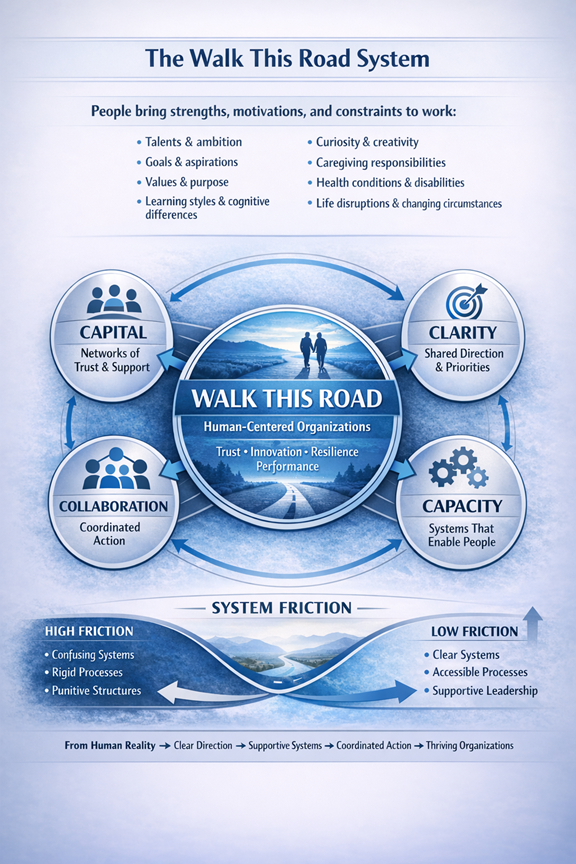
Reducing operational friction requires understanding where it originates. The “Walk This Road System” identifies four key areas:
1. Capital: Skills and Relationships That Carry the Work
Both human capital (skills, training, problem-solving ability) and social capital (relationships, trust, and access to resources) shape how work gets done.
Understanding who people rely on to solve problems and how those connections function reveals hidden opportunities to reduce friction.
2. Clarity: What Matters Most
When priorities are unclear, people work hard, but in different directions.
If individuals across the organization define “what matters” differently, friction increases. Alignment reduces unnecessary effort and confusion.
3. Capacity: How Work Actually Gets Done
Capacity is reflected in day-to-day workflows.
Moments when employees hesitate, double-check, or create workarounds signal friction in systems. These are the points where processes need redesign.
4. Collaboration: How Work Moves Across Teams
Many breakdowns occur not within teams, but between them.
Every handoff, from sales to operations, operations to logistics, customer service to accounting, creates the potential for friction. Improving these transitions reduces delays and errors.
What Creates Operational Friction?
A common underlying issue is that organizations design systems for a “standard human” who does not exist.
These systems assume people:
- Have unlimited time
- Process information quickly
- Remember details easily
- Navigate complexity without difficulty
In reality, both employees and customers operate under many constraints, such as deadlines, competing priorities, and limited attention.
When systems fail to reflect these realities, friction increases. When systems align with how people actually work, outcomes improve.
The Business Impact of Reducing Operational Friction
Organizations that address friction before or alongside AI adoption see measurable results:
- Stronger customer experience: Faster, more consistent responses
- More engaged employees: Less time navigating obstacles
- Better use of data: Greater confidence in decision-making
- Revenue impact: Improved retention, growth, and performance
In these environments, AI supports people rather than replacing them and its value increases accordingly.
__________________
Why Leadership Matters
Reducing operational friction is not a technology problem; it’s a leadership challenge.
Identifying where work breaks down, aligning teams, and redesigning processes requires experienced leaders who can see across the organization and act decisively. With that kind of leadership, AI becomes a true force multiplier.
That’s where InterimExecs comes in. Our RED Team-vetted executives bring the experience, objectivity, and execution focus needed to reduce friction, realign operations, and position your organization for successful AI implementation.
If you’re preparing for AI, or not seeing the results you expected, call us at 847.849.2800 or contact us online for a confidential conversation about how to move forward with clarity and confidence.
Read More
Frequently Asked Questions
Operational friction refers to the small inefficiencies that slow down work or reduce effectiveness. This includes duplicate processes, unclear priorities, miscommunication between teams, delays, and inconsistent data. While each issue may seem minor, collectively they create significant drag on performance.
There are many reasons AI implementation fails, including lack of skilled leadership. Another reason: flawed systems. Instead of fixing underlying issues, AI accelerates them, scaling poor data quality, inefficient workflows, and misaligned teams. Without addressing these problems first, organizations see limited or negative returns on AI investments. One good way to address these challenges is to bring in highly skilled interim or fractional leadership from the InterimExecs RED Team to oversee AI implementation.
No. AI improves the speed and scale of existing processes, but it does not inherently fix them. If a process is inefficient or poorly designed, AI will typically make those inefficiencies happen faster and more consistently.
Organizations should first identify and reduce operational friction by:
Bringing in skilled leadership, such as hiring an interim CIO who has experience with AI implementation.
Clarifying priorities
Improving data quality
Streamlining workflows
Strengthening collaboration across teams
Common signs include:
- Employees re-entering the same data
- Conflicting answers to simple questions
- Frequent handoff issues between teams
- Delays in responding to customers
- Workarounds becoming standard practice
These are indicators that systems need to be redesigned before introducing AI, a job that is made for strong interim leadership such as a rock star interim CEO who can streamline operations so the company is ready to take advantage of AI.