847.849.2800
 Contact
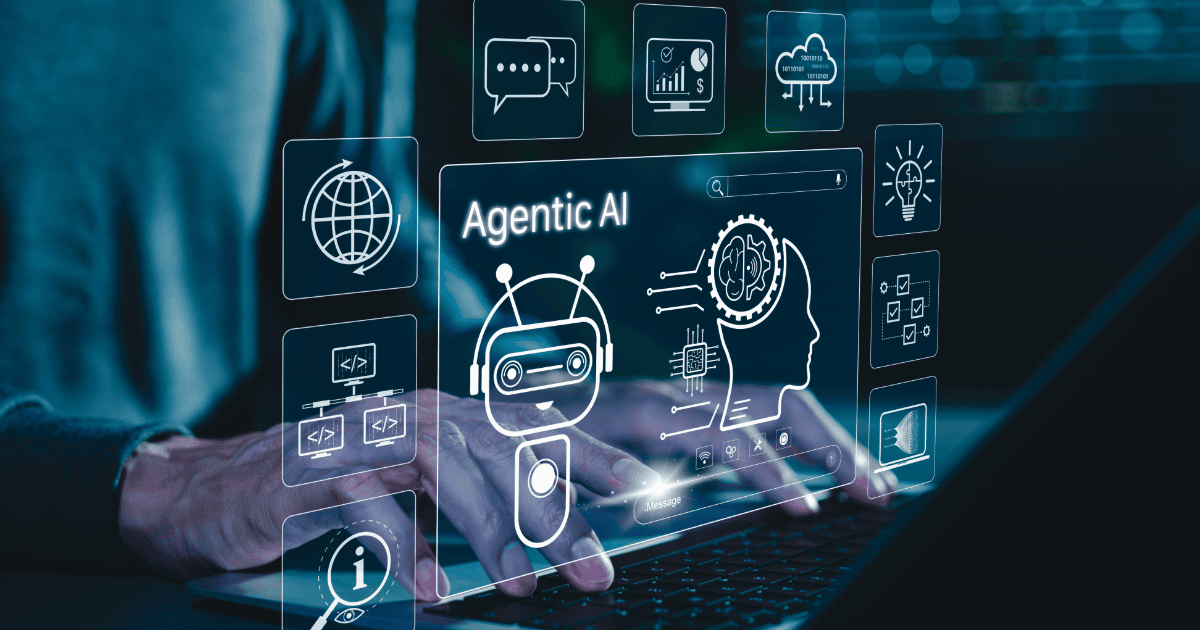
“Agentic AI” is one of the hottest terms out there. But what does agentic AI really mean? It’s not chatbots, copilots, or incremental automation. That is so last week in our AI-fueled world.
In our interview with an Interim CIO who has led multiple deployments, the distinction was clear: agentic AI isn’t about assisting users, it’s about artificial intelligence agents actually doing the work.
And it’s big. Really big. In fact, Nvidia CEO Jensen Huang said in his keynote address at the 2025 Consumer Electronics Show that enterprise AI agents would create a “multi-trillion-dollar opportunity” for many industries, from medicine to software engineering.
So how do you get a piece of that?
The Three Functions of Most Software
Across industries, most applications do three things:
- Capture data
- Route workflows
- Produce reporting
This structure hasn’t changed for decades.
Agentic AI introduces a new layer where the system performs these steps directly.

AI Agents Don’t Assist, They Execute
As the CIO says: “Agentic transformation is the agent breaking through the screen… doing the user’s job.”
Instead of a user moving through multiple screens, an AI agent processes tasks behind the scenes.
That changes how organizations think about productivity, workforce, and resource allocation.
Why This Is More Than Automation
Traditional automation required:
- rigid rules
- extensive engineering
- long implementation cycles
Agentic systems are different because they can:
- interpret context
- read unstructured data
- adapt based on guidance
In the interview, the veteran CIO shared examples of agents reviewing contracts, analyzing claims, and performing complex data tasks that previously required teams of specialists.
The result wasn’t just faster processing; it was a fundamentally different way of organizing work.

You Still Need Humans
Agentic AI does not eliminate expertise.
“You still need the expert. Somebody’s got to look at the output of the agent and go, ‘That’s right,’” says the CIO.
Expert supervision, escalation paths, and judgment remain essential. Leaders move from managing repetitive tasks to guiding outcomes, refining how AI agents behave over time.
Why Companies Need Interim CIO Leadership
Because agentic AI transformation touches workflows, staffing models, and operating structures, companies need experienced leadership to guide the shift.
That’s where our vetted, experienced Interim and Fractional CIOs and CTOs make the difference.
They don’t “talk about AI;” they operationalize it safely and credibly. And they can be on-site in as little as 48 hours, engaging for your specific mandate, enabling your team, and delivering results.
Contact Us
You can learn more about InterimExecs’ Executive AI Transformation approach. Or you can reach out to us directly online or via phone or text at 847.849.2800 for a confidential conversation about how our RED Team executives can solve your agentic AI challenges, because the question is no longer whether agentic AI will reshape the market but how quickly your organization will adapt so it can lead the change.
Read More
Frequently Asked Questions
Agentic AI is a type of artificial intelligence that can independently plan, make decisions, and take action to achieve a goal. Unlike traditional AI tools, it doesn’t just respond to prompts—it executes multi-step tasks with minimal human input, acting more like a digital operator than an assistant.
Agentic AI differs from generative AI by focusing on action rather than content creation. While generative AI produces text, images, or code, agentic AI uses reasoning to plan and complete tasks end-to-end—often coordinating multiple systems without constant human direction.
Agentic AI can automate complex workflows such as processing invoices, managing supply chains, analyzing contracts, or handling customer service resolutions. These systems can make decisions, trigger actions, and adapt in real time, reducing the need for manual oversight. Setting the right commands and standards for agentic AI is critical. That is why experienced leadership, such as an interim CIO who has worked in agentic AI, is so important.
Agentic AI does not replace human workers but shifts their role. It automates execution-heavy tasks, allowing humans to focus on strategy, oversight, and decision-making. Organizations still rely on people to guide AI systems, validate outcomes, and manage exceptions.
Agentic AI is important because it enables faster, more scalable operations in an increasingly complex business environment. Companies can streamline workflows, reduce costs, and respond more quickly to change by deploying systems that act autonomously while staying aligned with business goals.